
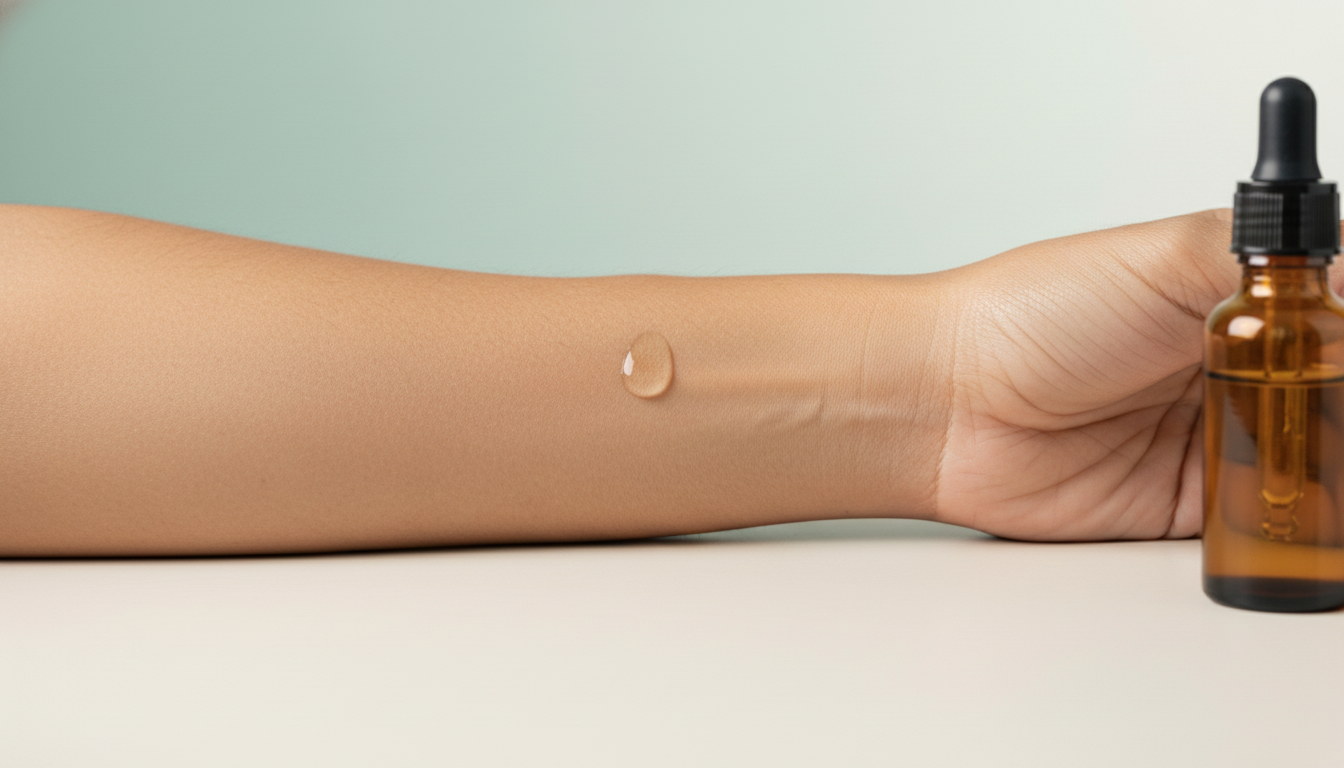
How to Patch-Test a New Skincare Product (the Right Way)
Most bad skincare reactions are predictable. They happen because someone applied a new product to their entire face on day one, and by day three they're dealing with redness, breakouts, or stinging that they could have caught early with a 5-minute patch test on a small area.
Patch testing isn't complicated, but very few people actually do it — partly because the standard "apply to inner wrist for 24 hours" advice is a watered-down version that catches only the most aggressive reactions and misses the subtler ones that build up over a week. This post walks through a more useful 7-day protocol, where to actually test (the wrist is not the best place), and what to do when something does react.
This sits inside our skincare cluster — for the broader principles of skincare in South African climates, see the pillar. For label literacy that helps you avoid the worst reactions in the first place, see our skincare label terms guide.
Why a 5-minute test isn't enough
The classic "rub a bit on your inner wrist for 24 hours" advice catches one specific kind of reaction — acute contact irritation. If a product is going to make your skin red and itchy within an hour, the wrist test will reveal it.
What the standard test misses:
- Delayed reactions (cumulative irritation that takes 2-5 days to appear)
- Allergic contact dermatitis (often shows on day 3-7, not day 1)
- Comedogenic clogging (takes 5-10 days to manifest as blocked pores)
- Skin reactions that only appear on facial skin (different from wrist skin)
- Interactions with other products in your routine (the test product alone might be fine, but combined with what you already use, problems develop)
A more useful protocol is 5-7 days, on facial skin, and includes the rest of your routine.
A 7-day patch test protocol that actually works
Day 0 — Prepare
- Cleanse your test area gently (just water or your usual cleanser).
- Don't use other actives (retinol, AHA, BHA, Vitamin C serum) on the test area for 24 hours before starting. They can mask or amplify reactions.
- Take a clear-light photo of the test area for a baseline. Phone photos are fine.
Day 1 — First application
- Apply a small amount of the new product to the test area (more on where, below).
- Use less than you would on the full face — about a quarter of the usual amount, since you're only covering a 2-3cm² zone.
- Let it sit for the same duration you would use it on your full face. If it's a leave-on product, leave it on. If it's a rinse-off product (cleanser, mask), follow the normal use instructions.
- Watch for the first 4 hours. Mild tingling can be normal for some active ingredients but should fade within 30 minutes. Persistent burning, intense itching, or visible swelling means stop immediately and rinse off — that's an acute reaction.
Days 2-3 — Continue daily application
- Apply once a day at the same time of day.
- Photograph the test area in similar lighting once per day.
- Watch for delayed irritation: redness that wasn't there yesterday, small bumps, dryness, or a tight feeling.
- Compare photos rather than relying on memory. Subtle changes are easier to see in a side-by-side than in real-time.
Days 4-5 — Increase frequency if compatible
- If no reaction by day 4, apply twice a day (morning and evening) for days 4 and 5.
- Still on a small area — you're testing tolerance to repeated exposure, not coverage.
- Watch for cumulative effects: barrier disruption sometimes shows on day 4-5 as flakiness or stinging that wasn't there on day 1.
Days 6-7 — Full-area trial (if compatible so far)
- If everything looks fine through day 5, expand to a larger area — half the face — for days 6 and 7.
- Watch for asymmetric reactions — if one side of the face is reacting and the other (untested) side is fine, the product is the cause.
- Look for breakouts in the test area — clogging usually shows on day 5-8 if it's going to happen.
Day 8 — Full face commit (or not)
- If days 0-7 are clear, the product is safe enough to use on your full face.
- If any of the above triggered a reaction, abandon the product or try at a much lower frequency (2× per week instead of daily).
Where to actually patch-test
The standard inner-wrist advice is convenient but not ideal. Wrist skin is structurally different from facial skin — generally thicker, less sensitive, with different oil and bacterial profiles. A product that's fine on your wrist can still react on your face.
Better test locations, in order of usefulness:
1. Behind the ear / along the hairline
The skin behind the ear is similar in thickness and oil profile to facial skin. It's easily hidden if a reaction develops. Most dermatologists patch-test here for serious sensitivity assessments.
2. Side of the neck (under the jaw)
Similar skin profile to face, easily covered with a scarf or collar if you react, and you'll notice irritation here quickly because it's a high-sensation area.
3. Inner forearm
Acceptable second choice. Less representative of facial skin than the ear or neck, but still better than inner wrist.
4. Cheek (small spot near hairline)
For products you're already fairly confident about, a small spot near the hairline lets you test on actual facial skin while keeping the reaction in a visible-but-not-prominent area.
Where NOT to test
- Eye area — too sensitive, reactions there are disproportionate
- Lips — same as above
- Open or healing skin — any active blemish, cut, or recent treatment area distorts results
- Inner wrist alone — fine as part of an initial screen but not sufficient
What a real reaction looks like
Knowing what to watch for matters. Reactions fall into a few categories:
Acute irritant contact dermatitis
- Timing: Within minutes to hours of application
- Appearance: Red, hot, may itch or sting, may develop small blisters
- Cause: The product contains something that mechanically or chemically irritates the skin
- What to do: Rinse off immediately with cool water, apply a layer of Curaloe Soothing Aloe Vera Gel for 24-48 hours, and discontinue the product
Allergic contact dermatitis
- Timing: Usually day 2-7 after first exposure (sometimes longer for cumulative allergies)
- Appearance: Red, itchy, sometimes raised bumps or small fluid-filled blisters, often spreads beyond the application area
- Cause: Your immune system has identified an ingredient as an allergen
- What to do: Discontinue immediately. If reaction is widespread or persistent beyond a few days, see a dermatologist for allergen identification. Note the product and try to identify the likely culprit ingredient for future avoidance.
Subclinical irritation (the most missed category)
- Timing: Develops gradually over days
- Appearance: Mild redness, dryness, slight stinging on application, skin "tightness"
- Cause: The product is slightly too harsh for your current barrier state
- What to do: This is where most "I tried it but my skin didn't love it" stories come from. Reduce frequency to 2-3× per week, buffer with a moisturiser or aloe layer, and see if tolerance develops over 2-3 weeks. If not, abandon.
Breakouts / clogging
- Timing: Day 5-14
- Appearance: New blackheads, whiteheads, or inflamed pimples in the application area
- Cause: An ingredient is comedogenic for your specific skin
- What to do: Discontinue and clear the breakouts with your usual approach before retrying anything new
"Purging" — the controversial category
- Timing: Week 1-3 of using a new active ingredient (retinol, AHA, BHA)
- Appearance: Increased breakouts that resolve faster than usual
- Cause: Accelerated cell turnover surfacing pre-existing clogs
- What to do: Real purging is short (under 3 weeks), happens only with cell-turnover actives, and the breakouts resolve faster than usual. Anything beyond 3 weeks of new breakouts is not purging — it's the product not working for you.
Special cases
Patch testing aloe gel
Curaloe Soothing Aloe Vera Gel is generally low-risk for reactions because the ingredient list is short and the inner-leaf aloe vera is one of the most-tolerated cosmetic ingredients across skin types. That said, true aloe allergy exists in a small percentage of the population, so a quick 2-3 day patch test on a new aloe product is still sensible.
Patch testing acids (AHA/BHA) and retinol
For active ingredients (glycolic, salicylic, lactic acid, retinol), expect some mild stinging and possible flaking on first use even on tolerant skin. A meaningful patch test for these requires a longer window (10-14 days) and a slower frequency ramp (every 3rd day for week 1, every 2nd day for week 2, daily after that if tolerated).
Patch testing in different climates
If you're testing in dry Cape Town winter, the same product may behave differently in humid Durban summer. Re-test if you move climates or if conditions change significantly.
For city-specific routines, see our summer skincare guide.
When to stop testing and see a professional
Patch testing handles routine consumer purchases. See a dermatologist if:
- A reaction is severe (blistering, widespread spreading, fever)
- A reaction persists beyond 5-7 days after discontinuing the product
- You're reacting to multiple unrelated products, suggesting a sensitised skin barrier
- You suspect a specific allergen and want it identified (patch testing in clinical settings can identify specific allergens you can then avoid for life)
FAQ
Can I skip the patch test if a product worked for a friend?
Their skin isn't your skin. Common allergens (fragrance, essential oils, lanolin, formaldehyde-releasers) react very differently between individuals. Always patch test.
Is patch testing necessary for "natural" or "clean" products?
Yes. Plant ingredients are some of the most common cosmetic allergens (essential oils especially). "Natural" doesn't mean "low-reaction-risk."
Can I patch-test multiple products at once?
Only if you apply them in clearly separated areas and label which is which. Otherwise you won't know which one caused a reaction.
What if I'm pregnant or breastfeeding?
Skin sensitivity changes during pregnancy. Re-patch-test products you tolerated before, and avoid known pregnancy-questionable ingredients (high-strength retinol, certain essential oils) regardless of how your skin reacts.
How long is a patch test result valid?
For the same product from the same brand, indefinitely — unless they reformulate. Skincare formulations do change; if a product you've used for years suddenly reacts, the formula may have shifted.
Note: Curaloe products are topical cosmetics, not medicines. If you have a diagnosed skin condition or are using prescription topicals, please consult your dermatologist before adding new products. Information in this post is educational and not medical advice. Severe skin reactions require medical attention.
Related: Why Curaloe grows Aloe vera (Aloe barbadensis Miller), not Aloe ferox →


Leave a comment
This site is protected by hCaptcha and the hCaptcha Privacy Policy and Terms of Service apply.