
Aloe Barbadensis vs Aloe Ferox: The Complete Science Guide for South African Skin
South Africa is aloe country. From the wild Aloe ferox of South Africa's mountain regions to the cultivated rows of Aloe Barbadensis Miller on our own plantation in Limpopo, we are — by accident of geography — one of the few places on earth where both of the world's most important aloe species grow side by side.
That's also why we hear the question almost every week:
"Is Aloe Ferox better than Aloe Vera? Aren't they the same thing? Which one should actually go on my skin?"
The short answer: they are different plants, with different chemistry, and different best-uses. The long answer is a short journey through botany, history and a stack of peer-reviewed research — everything you need to pick the right aloe for the right purpose. Let's start at the beginning.
Which aloe does Curaloe use?
Curaloe grows one species only: Aloe vera (Aloe barbadensis Miller), certified organic, on our own farm in Limpopo — no aloe ferox. Why we chose barbadensis.
Aloe Vera Juice 1L – R239 · Soothing Aloe Vera Gel 150ml – R199 · Aloe Vera Capsules – R359
1. First, the vocabulary problem
"Aloe vera" is the name almost everyone uses, but in the science literature it only refers to *one specific species: Aloe barbadensis Miller (also written Aloe vera* L.). Every other aloe — and there are over 500 species — has its own name.
In South Africa, two dominate:
| Common name | Scientific name | Origin | Native to SA? |
|---|---|---|---|
| Aloe Vera / True Aloe | Aloe barbadensis Miller | Arabian Peninsula; now cultivated globally | Cultivated in SA (incl. Curaloe's ACAP plantations) |
| Cape Aloe / Bitter Aloe | Aloe ferox Miller | Western & Limpopo, South Africa | Indigenous |
They are close cousins in the botanical family Asphodelaceae, but their chemistry, potency, and therapeutic record differ meaningfully. Calling both "aloe vera" on a product label is common, but it's imprecise — and for people who care about what goes on their skin, the distinction matters.
2. Inside the leaf: what actually makes aloe work
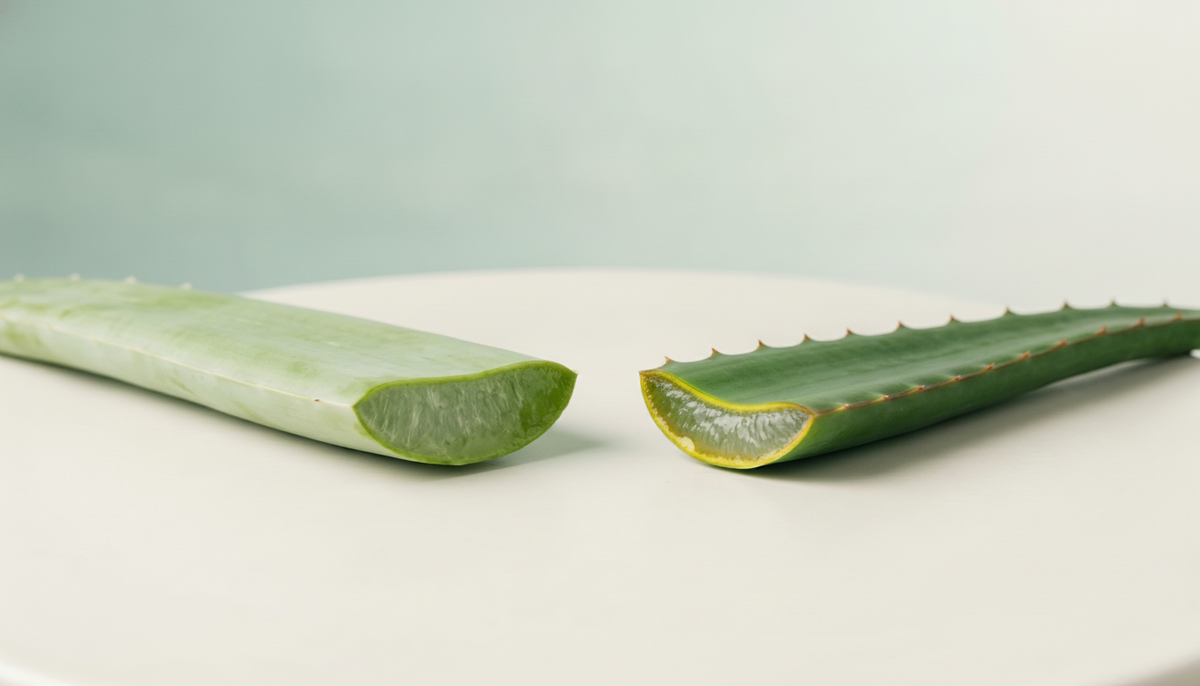
When you cut open any aloe leaf, you find three distinct layers:
- The outer rind (exocarp) — tough, waxy, protects the plant.
- The yellow sap (aloin layer / latex) — just below the rind. High in anthraquinones like aloin and emodin.
- The inner gel (mesophyll / parenchyma) — the clear, cool gel you see. Rich in polysaccharides (mainly acemannan), vitamins, amino acids, enzymes and minerals.
Almost all of aloe's reputation for soothing, healing and hydrating skin comes from the inner gel. The yellow sap, by contrast, is a strong laxative — and this is where the two species diverge sharply.
Aloe Ferox: the latex king
Aloe Ferox has one of the highest aloin (anthraquinone) concentrations of any aloe species. That's why its dried sap has been used for centuries as "Cape Aloes" — a traditional laxative exported from South Africa since the 1700s. For internal, digestive-transit applications, Ferox is historically unmatched.
Aloe Barbadensis: the gel king
Aloe Barbadensis has a far larger inner gel layer relative to its leaf size, with the highest concentration of acemannan — the long-chain polysaccharide that drives most of aloe's topical wound-healing, hydration and anti-inflammatory research. It is, by a wide margin, the most clinically studied aloe species on earth.
In other words: Ferox is built for the gut. Barbadensis is built for the skin. Both are useful — but for different jobs.
3. What the research actually says
Here the two species aren't equal in one important regard: published studies.
A PubMed search in 2026 returns:
- Aloe barbadensis / aloe vera: 6,000+ published studies
- Aloe ferox: ~200 published studies
That's a ~30× gap, and it reflects nearly a century of concentrated laboratory and clinical work on A. barbadensis as the scientific reference species. When a dermatologist or formulator says "aloe vera", they almost always mean the plant we grow.
Highlights from the peer-reviewed literature on Aloe barbadensis:
- Burns and wound healing. A systematic review in Journal of the Medical Association of Thailand (Maenthaisong et al., 2007) found A. barbadensis gel shortened first-degree and second-degree burn healing time by an average of 8.79 days vs. control.
- Psoriasis. A randomised, double-blind trial (Syed et al., Tropical Medicine & International Health, 1996) showed a topical 0.5% aloe vera extract cream cleared psoriasis plaques in 83% of patients vs. 7% placebo.
- Diabetic wound healing. Multiple studies (e.g., Annals of Plastic Surgery, 2009) demonstrate improved re-epithelialisation.
- Anti-ageing / skin hydration. A 90-day randomised trial (Cho et al., Annals of Dermatology, 2009) showed daily oral aloe gel supplementation significantly improved wrinkle scores and elasticity in women over 45.
- Acne vulgaris. Combined with tretinoin, A. barbadensis gel has been shown to reduce inflammatory lesions more than tretinoin alone (Hajheydari et al., 2014).
Highlights for Aloe ferox:
- Laxative efficacy. The anthraquinone content of Ferox latex is medicinally recognised (SA's own pharmacopoeia lists it).
- Antioxidant activity. Ferox gel shows strong in vitro antioxidant capacity (Chen et al., 2012), often on par with barbadensis.
- Topical wound data is emerging but much thinner. Most Ferox work is still in vitro or animal-model; human clinical trials are limited.
The honest summary: both species share a core skincare profile (soothing, hydrating, antioxidant-rich), but the weight of clinical evidence for topical skin applications sits overwhelmingly with Aloe Barbadensis Miller. That's not marketing — that's a simple count of studies.
4. Potency: where the numbers actually matter
If you read product labels in South Africa, you'll see aloe percentages thrown around. Here's what they actually mean:
| What's on the label | What it usually means |
|---|---|
| "Made with aloe vera" | Could be as little as 0.1% extract |
| "Contains 30% aloe vera" | 30% of the formula is aloe juice or gel by weight |
| "98% Aloe Barbadensis" | 98% of the product is pure aloe, 2% preservatives or vehicle |
| "Organically grown" | The aloe source is certified organic — but says nothing about concentration |
The acemannan content — the active molecule behind most of aloe's skin benefits — is what really matters for efficacy. Acemannan is:
- Fragile. Heat, oxidation and long processing destroy it.
- Species-dependent. Barbadensis naturally contains 2–3× more acemannan than Ferox.
- Harvest-dependent. Leaves picked in the early morning, aged 3–5 years, from plants grown in healthy soil carry the highest concentration.
This is exactly why how and where aloe is grown matters as much as which species. A 98% Aloe Barbadensis juice from a continuously harvested, intensively farmed plantation can have less active acemannan than a 70% juice from a mature, slow-grown, organically managed farm.
At Curaloe, we grow Aloe barbadensis Miller on our own ACAP-certified plantation in South Africa. The leaves we harvest are 3–5 years old, hand-cut, filleted within hours and cold-pressed to preserve acemannan. The product in your bottle is both high-% and high-activity — the two don't automatically travel together.
5. Ferox vs Barbadensis: the side-by-side
| Aloe Barbadensis Miller | Aloe Ferox | |
|---|---|---|
| Common name | Aloe Vera, True Aloe | Cape Aloe, Bitter Aloe |
| Origin | Arabian Peninsula (now cultivated globally) | Western & Limpopo, SA — indigenous |
| Appearance | Shorter, greener, pale-yellow flower | Tall, red-tipped, bright red/orange flower |
| Inner gel size | Large — bulk of the leaf | Smaller, narrower |
| Key actives (gel) | Acemannan (high), polysaccharides, vitamins A/C/E, minerals | Acemannan (lower), polysaccharides, antioxidants |
| Key actives (latex/sap) | Aloin (low–medium) | Aloin (very high) |
| Strongest use case | Topical skincare, wound healing, hydration, oral supplementation | Digestive / laxative (latex); emerging skincare (gel) |
| Clinical studies | 6,000+ (PubMed, 2026) | ~200 (PubMed, 2026) |
| Taste (juice) | Mild, slightly bitter | Noticeably bitter |
| Best for | Daily skincare, sensitive skin, anti-ageing, supplementation | Traditional digestive support; niche skincare |
6. Why this matters for your routine
The "right" aloe depends entirely on what you're trying to do.
For skincare (face, body, hair, burns, wounds) — Aloe Barbadensis Miller is the evidence-based choice. The higher acemannan, larger inner-gel yield, and the sheer volume of clinical research make it the default recommendation of most dermatologists and formulators worldwide.
For digestive support — Aloe Ferox has the traditional and pharmacopoeial track record, thanks to its high aloin content. (Note: aloin is strong. It should only be used short-term and never during pregnancy. Aloe Barbadensis juice sold for drinking is typically decolourised — the aloin removed — so it is safe for daily consumption.)
For celebrating South African indigenous botanicals — Aloe Ferox has a beautiful story. It grows wild across our landscape. It is part of our heritage. We have deep respect for the plant and the producers working with it.
The choice isn't tribal. It's functional. At Curaloe, we chose Aloe barbadensis Miller because we are in the business of skin and daily wellness — and the science led us there. We grow it here, cold-press it here, bottle it here. "Proudly South African" doesn't have to mean "indigenous species only". It can also mean: we chose the best-studied tool for the job and we built the farm, the lab and the factory right here at home.
7. How to read an aloe product label (quick checklist)
Before buying any aloe skincare or juice, look for:
- ✅ The specific species name — Aloe barbadensis Miller or Aloe ferox. "Aloe vera" without the scientific name is a soft signal.
- ✅ The % of aloe in the formula. Higher is usually better — but only if the processing is cold/gentle.
- ✅ "Cold-pressed" or "inner-leaf only" processing claims.
- ✅ Certification — ACAP, Ecocert, NOP, Kosher, Halal, HACCP for reputable producers.
- ✅ Country of origin of the aloe itself — not just where the product is packaged.
- ❌ Beware of ambiguous labels, undisclosed percentages, and "fragrance / perfume" high up the ingredient list (aloe works with your skin — it doesn't need covering up).
8. The Curaloe approach
We grow Aloe barbadensis Miller on our own ACAP plantation in South Africa. We harvest leaves aged 3–5 years, fillet them within hours, and cold-press the inner gel to preserve the acemannan content. Our juices and skincare formulas disclose their aloe percentage on the front label. We don't hide behind generic "aloe vera" claims — we tell you the species, the concentration, and where it came from.
You can explore our range by skin concern, by routine step, or start with the bestsellers:
- Curaloe Aloe Vera Juice 1L — 98% Aloe Barbadensis — daily wellness.
- Curaloe Facial Gel Hyaluronic Acid Serum — 89% Aloe Barbadensis — lightweight daily hydration.
- Curaloe Soothing Aloe Vera Gel 150ml — 97% Aloe — multi-purpose soothe for burns, bites and post-sun.
9. Frequently asked questions
Is Aloe Barbadensis better than Aloe Ferox?
"Better" depends on the use case. For topical skincare and daily oral supplementation, Aloe Barbadensis is the better-studied, higher-acemannan choice. For short-term digestive stimulation, Aloe Ferox latex has the strongest traditional record. They are complementary species, not competitors.
Is Aloe Barbadensis indigenous to South Africa?
No — it originated in the Arabian Peninsula. However, it is now widely cultivated in SA, including on our own ACAP plantation. Being "Proudly South African" doesn't require indigenous status; it requires being genuinely grown, processed and bottled here.
Can I use Aloe Ferox on my skin?
Yes, many skincare brands use Ferox gel and it has emerging research support. It is a fine ingredient — just not as extensively studied as Barbadensis for topical applications.
Why do some aloe juices warn against pregnancy use?
Because of the aloin content. High-aloin aloe (typically Ferox latex or whole-leaf preparations) stimulates the gut and should be avoided during pregnancy and breastfeeding. Decolourised or inner-leaf-only Barbadensis juice — which is what we produce — has the aloin removed and is generally considered safe for daily use. If you are pregnant or on medication, please consult your healthcare professional before using any aloe product.
How do I know if my aloe product is actually potent?
Three signals: (1) the species is disclosed, (2) the % is disclosed, (3) the processing is described as cold-pressed / inner-leaf. A 98% cold-pressed Barbadensis juice is a different product from a 98% "aloe vera extract" blend of uncertain heat-treatment.
10. Sources & further reading
- Maenthaisong R, et al. Journal of the Medical Association of Thailand, 2007 — systematic review of aloe vera on burn healing.
- Syed TA, et al. Tropical Medicine & International Health, 1996 — randomised controlled trial in psoriasis.
- Cho S, et al. Annals of Dermatology, 2009 — oral aloe and skin ageing.
- Hajheydari Z, et al. Journal of Dermatological Treatment, 2014 — aloe vera and tretinoin in acne.
- Chen W, et al. Food and Chemical Toxicology, 2012 — comparative antioxidant activity of A. ferox and A. vera.
- Grace OM, et al. South African Journal of Botany — on the history and taxonomy of Aloe ferox.
This article is for education. It is not medical advice. If you have a specific skin condition or medical question, consult a qualified healthcare professional.
Written by the Curaloe team. Grown here. Proven here.
Related: Why Curaloe grows Aloe vera (Aloe barbadensis Miller), not Aloe ferox →

Leave a comment
This site is protected by hCaptcha and the hCaptcha Privacy Policy and Terms of Service apply.