

Acemannan: The Key Compound That Separates Quality Aloe Juice from a Sugar Drink
Short answer: acemannan is a polysaccharide, a long chain of sugar molecules, that Aloe barbadensis Miller produces naturally in the inner leaf gel of the aloe vera plant.
If you've ever wondered why two bottles labelled "aloe vera juice" can taste different, look different, and cost wildly different amounts — the answer almost always comes down to one molecule.
It's called acemannan, and it's the long-chain polysaccharide that gives quality Aloe barbadensis Miller its distinctive composition. It's also the part of the aloe leaf that's most easily destroyed by bad processing — which is why two products from the same plant species can have radically different acemannan content.
This post explains what acemannan is in plain English, why processing decides whether it survives to the bottle, and how you can read an aloe juice label to estimate whether you're paying for the real thing.
Where to find it at Curaloe
Our products are made from certified-organic Aloe barbadensis Miller grown on our farm in Limpopo. Prefer aloe in capsule form? Our Aloe Vera Capsules are dried inner-leaf powder — 60 capsules. Prefer to drink it? Try the Aloe Vera Juice 1L. Free delivery over R550.
For the broader comparison between Aloe barbadensis Miller and South Africa's indigenous Aloe ferox, see our Aloe Barbadensis vs Aloe Ferox science guide.
What acemannan actually is
Acemannan is a β-(1,4)-linked acetylated mannan polysaccharide. Strip the chemistry, and that's a long chain of sugar molecules — mannose units, with acetyl groups attached at intervals — naturally produced by Aloe barbadensis Miller in the inner leaf gel.
Three things make it interesting:
- It's characteristic of this aloe species. Other aloes have a different polysaccharide profile. Aloe ferox, the indigenous South African aloe, has a different composition and is naturally high in aloin. So when people talk about "the active ingredient in aloe vera," they almost always mean acemannan in Aloe barbadensis.
- It's a long molecule. Quality matters here — short, broken-up polysaccharide chains behave very differently from intact long-chain ones. The longer the chain, the more characteristic the molecule's behaviour.
- It's fragile. Heat, oxygen, enzymes, time, and aggressive filtering all degrade acemannan. The supply chain decisions a producer makes after harvest determine how much of it survives to the consumer.
Where in the plant it lives
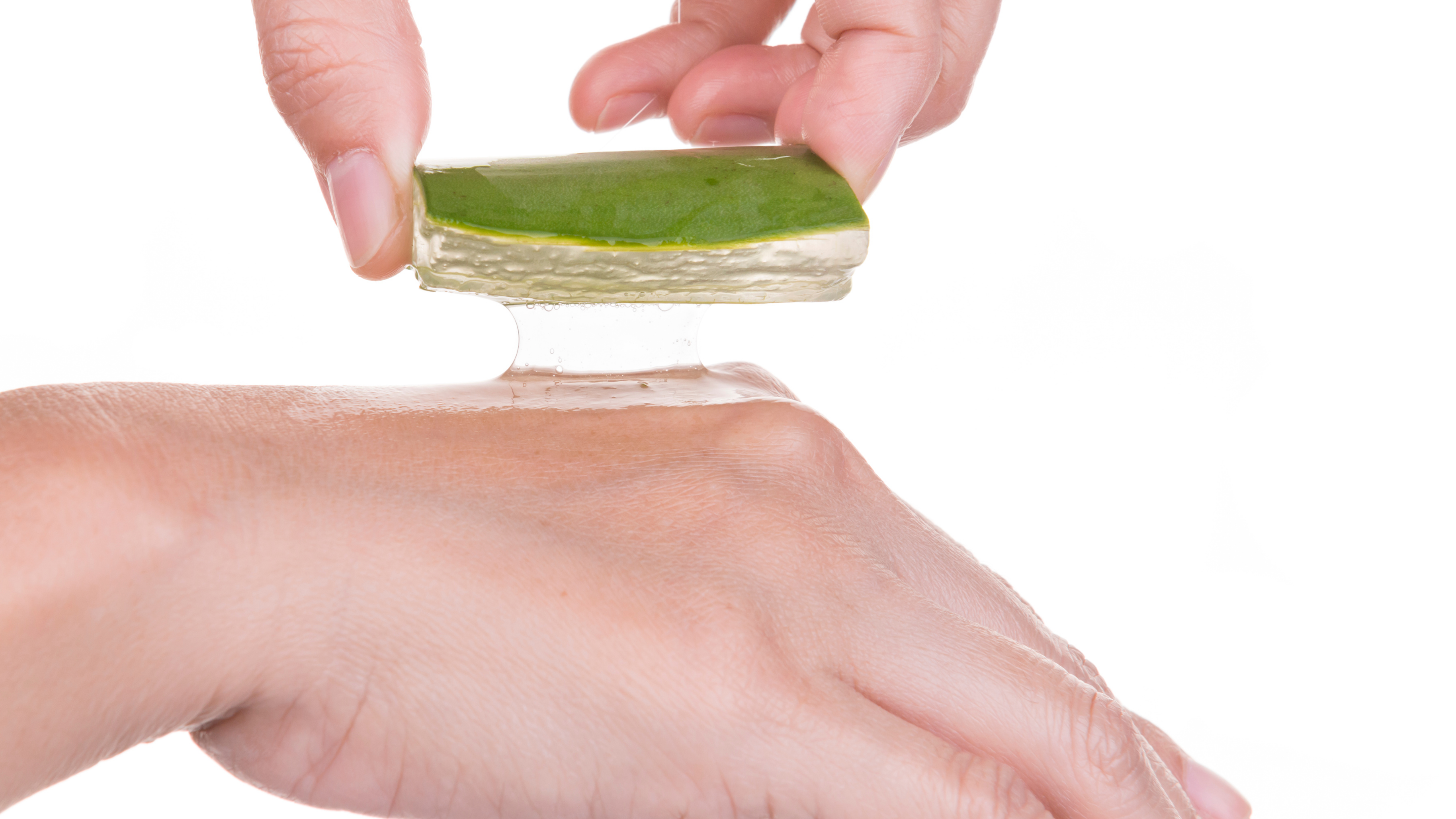
Cut open an aloe leaf and you find three distinct layers:
- Rind (outer skin): structural, no acemannan, mostly cellulose
- Latex layer (yellow sap): just under the rind. Contains aloin and other anthraquinones. Bitter, has a laxative effect, regulated as a medicinal compound in many countries.
- Inner gel (the clear stuff): this is where acemannan lives, along with water, vitamins, amino acids, enzymes and minerals.
When a producer says they use "inner-leaf juice," they're claiming to use only that third layer — the gel — and to have removed the rind and latex. That's the only way to get a meaningful concentration of acemannan into the bottle.
When a label just says "aloe vera juice" without specifying inner-leaf, the product may be whole-leaf: the entire leaf, rind and latex included, ground up and processed. Whole-leaf is cheaper to produce and yields more product per leaf, but it requires aggressive filtration to remove aloin — and that filtration step typically also breaks down acemannan.
Why processing decides acemannan content
Acemannan is fragile. Specifically, the long polysaccharide chain is vulnerable to:
1. Heat
Pasteurisation kills bacteria — but high-temperature pasteurisation also depolymerises acemannan. Producers who genuinely care about the molecule use low-temperature pasteurisation or, ideally, cold-pressing with minimal heat exposure.
At Curaloe, leaves are processed within a few hours of cutting, at the plantation in Vivo, Limpopo where they are grown. The shorter the time between cutting and pressing, the less degradation happens.
2. Oxidation
Once the leaf is cut, the inner gel starts to oxidise on contact with air. You can see this with the naked eye — fresh aloe gel is clear and pale; left in the open, it browns within hours. Each browning cycle takes acemannan with it.
This is why we process leaves within a few hours of cutting, and why we recommend refrigerating after opening — every additional oxidation cycle costs a little of what you paid for.
3. Enzymatic breakdown
Aloe leaves contain their own enzymes that, once the cell walls are broken, start to digest the polysaccharides. Cold pressing slows this down dramatically. Some industrial processors actually add stabilisers to inactivate these enzymes — which works, but raises its own questions about additive load.
4. Filtration
To remove aloin (the laxative compound) from juice, producers filter through activated carbon or specialised resin. Done well, this decolourises the juice (removes the yellow/brown tones from the latex) while preserving the acemannan. Done poorly — too aggressive, too hot, too long — it strips both aloin AND acemannan, leaving behind a clear liquid that's largely water and minerals.
For more on this trade-off, see Decolourised vs Whole-Leaf Aloe.
5. Reconstitution
The biggest acemannan killer of all: reconstitution from powder. Many supermarket "aloe vera juice" products are made by buying dried aloe powder from a commodity supplier, rehydrating it with water, adding flavourings or fruit juice, and bottling. The drying and rehydration cycle, plus the time spent as powder, leaves very little intact acemannan.
This is one reason a juice made from fresh leaves typically costs considerably more than a reconstituted product. The agricultural inputs, time-to-bottle, and processing standards are not comparable.
What "98% aloe" actually means
You'll often see percentages on aloe juice labels — 99%, 98%, 95%, 80%. The number tells you what fraction of the bottle is aloe juice. The rest is usually:
- Water — added during processing
- Preservatives — citric acid, potassium sorbate, sodium benzoate (typically 0.1–0.3% each)
- Optional additives — fruit juice, sweeteners, vitamins
What the percentage does not tell you is anything about acemannan content. Two bottles can both say "98% Aloe Vera Juice" while having vastly different acemannan concentrations, depending on processing.
For that reason, the percentage is a useful filter for avoiding clearly diluted products (anything below 90% deserves a second look) but it doesn't replace processing transparency.
What to look for on a label
A producer who genuinely preserves acemannan tends to disclose:
- Species (specifies Aloe barbadensis Miller, not just "aloe")
- Layer (specifies inner-leaf, not just "aloe vera juice")
- Processing (mentions cold-pressed or low-temperature)
- Origin (specifies where the plant is grown, not just where bottled)
- Decolourisation (mentions decolourised or aloin-reduced, with an aloin spec ideally — most quality producers target under 10 ppm)
Use this checklist on any aloe juice label, including our Aloe Vera Juice 1L. If a product can't answer these questions, that's information.
Acemannan in capsules
A common question: does aloe powder in capsule form retain acemannan?
The short answer: less than fresh juice, but more than reconstituted juice. A capsule contains aloe powder, which has been dried — and that drying step costs some acemannan. But capsules avoid the multi-month wet shelf life of a juice bottle, so once they're dry and sealed, the polysaccharide profile is reasonably stable.
For consumers who travel often or don't like the taste of fresh aloe juice, our Aloe Vera Capsules are a practical alternative. They contain 99% Aloe barbadensis Miller inner-leaf powder from the same plantation as the juice — just in a different physical format.
The juice still wins on freshness and serving flexibility (mix into smoothies, drink straight, dilute with water). Capsules win on portability. Neither is "better" — they're optimised for different routines.
Frequently asked questions
Q: How much acemannan does Curaloe juice contain?
A: We don't print a number on the label because our process targets preservation rather than concentration to a specific dose. Aloe juice is not a pharmaceutical — it's a traditional wellness drink with a characteristic compositional profile. Our quality control focuses on starting with the right species, harvesting mature leaves by hand, and processing gently, avoiding high heat and aggressive filtration that would degrade the polysaccharide chain. If you need a third-party batch analysis for personal records, email hello@curaloe.co.za.
Q: Is acemannan the only reason to drink aloe juice?
A: It's the most distinctive component, but quality aloe juice also contains vitamins (notably C and small amounts of B-complex), trace minerals, amino acids, and other polysaccharides at smaller scale. Acemannan is the "signature" molecule but not the whole story.
Q: Why is your juice 98% aloe and not 100%?
A: A 100% aloe juice with no preservatives would not survive shelf storage — it would either need to be frozen (commercially impractical) or it would spoil within days. The remaining 2% is a small preservation system that keeps the juice stable on the shelf. Any shelf-stable "100% aloe" claim is either misleading or relies on aggressive heat treatment that costs acemannan.
Q: Does mixing aloe juice with fruit juice destroy acemannan?
A: No — acemannan is stable at the mild pH of fruit juices and at room temperature for the duration of a drink. The concern is only about long-term storage, not short-term mixing.
Q: How can I tell if a juice has degraded?
A: Visual cues: a brown or amber colour (vs. pale gold/colourless) often indicates oxidation. A strong bitter taste suggests aloin breakthrough (incomplete decolourisation). A flat or sweet taste with no characteristic aloe earthiness may indicate reconstitution.
What this means in practice
If you want acemannan in your daily wellness routine, the framework is simple:
- Buy single-species Aloe barbadensis (not blended with ferox or other species)
- Buy inner-leaf, not whole-leaf (read the label)
- Buy cold-pressed (or low-temp pasteurised, not just "pasteurised")
- Buy from a producer that controls the supply chain (farm-to-bottle, not powder rehydrated)
- Keep it cool, drink it fresh — refrigerate after opening, consume within 30 days of opening
Our 1L Curaloe Aloe Vera Juice is the most cost-effective format for daily home use. The 500ml suits travel and trial. The capsules suit people who prefer to skip the taste entirely.
For the broader question of why Aloe barbadensis rather than Aloe ferox — and why "True Aloe" matters for skincare too — see our Aloe barbadensis vs Aloe ferox guide.
Note: Curaloe products are food supplements, not medicines. If you are pregnant, breastfeeding, on prescription medication, or have a chronic condition, please consult your healthcare provider before adding any supplement to your routine. Information in this post is educational and not medical advice.
Related: Why Curaloe grows Aloe vera (Aloe barbadensis Miller), not Aloe ferox →

Leave a comment
This site is protected by hCaptcha and the hCaptcha Privacy Policy and Terms of Service apply.