
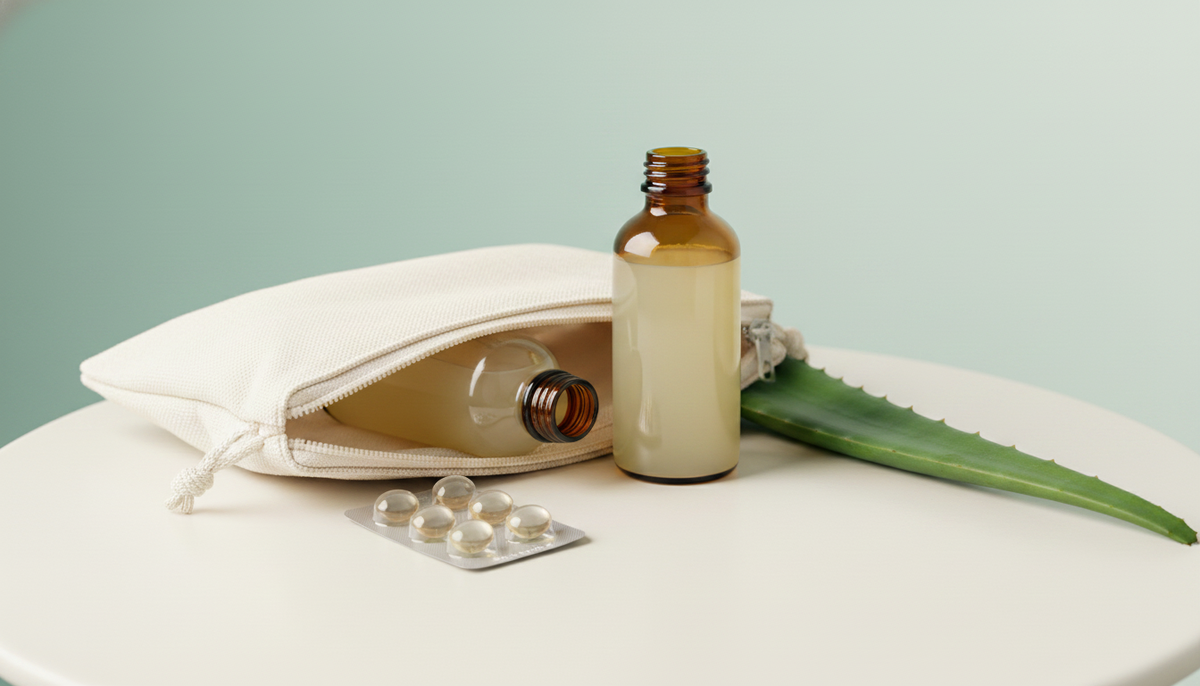
Travel-Friendly Aloe: Why 500ml & Capsules Are the Globetrotter's Choice
A daily aloe juice routine is easy at home — the 1L bottle lives in the fridge, you pour 30-60ml into your morning glass, and the rhythm sustains itself. Travel breaks the rhythm. Long-haul flights have a 100ml liquid rule that kills the 1L. Hotel rooms don't always have fridges. Road trips through Limpopo and the Lowveld don't have refrigeration windows long enough to keep a 1L bottle sensible.
This post is about how to keep the routine going on the move. The short version: the 500ml Wellness Boost juice and the aloe vera capsules solve different travel problems, and choosing well between them depends on the trip.
For the base daily routine that you're trying to maintain on the road, see our Daily Aloe Juice Ritual guide.
The travel constraints that matter
Five practical constraints break down "just bring the usual bottle":
1. Airline liquid rules
For international flights and most domestic ones, anything over 100ml in hand luggage gets confiscated at security. The 1L Curaloe bottle is a 10× violation. Even the 500ml bottle exceeds the threshold and has to go in checked baggage.
2. Refrigeration availability
Aloe juice needs refrigeration after opening; use the guidance on the label for how long an opened bottle keeps. A hotel mini-bar fridge works. Road-trip cool boxes work for a couple of days. A backpack in midsummer Kruger heat does not.
3. Weight and bulk
A 1L glass or PET bottle weighs ~1.1kg with packaging. Times that by a multi-week trip and you're carrying a meaningful percentage of your luggage allowance in fluid. A jar of 60 capsules weighs ~50g.
4. Hotel cleaning staff
Open juice bottles in shared accommodation can be moved, "tidied up", refilled, or thrown away by housekeeping. A sealed bottle is fine; an opened bottle is a small risk.
5. Customs
Liquids over certain volumes can trigger declaration requirements at some borders. Capsules are food supplements and travel almost universally without issue. Juice is more variable.
When to choose the 500ml bottle
The 500ml Wellness Boost is the right tool for:
- Road trips within South Africa. No security checkpoint, so you can travel with one in the cooler bag.
- Domestic flights with checked baggage. Pack it sealed in a leak-proof bag inside checked luggage; arrive at your accommodation, open and refrigerate.
- Weekend getaways and Airbnb stays of 1-2 weeks where the destination has a fridge.
- Travelling with family where someone else is also drinking it (faster turnover, doesn't sit half-opened).
- People who specifically want the daily juice experience — taste, ritual, mouthfeel — and are willing to plan around the logistics.
The 500ml is the same inner-leaf juice as the 1L — same Limpopo farm, same processing — just sized for the use case. We unpack the production side in our cold-pressed vs reconstituted post.
Practical packing tips for the 500ml bottle
- Wrap in a sealed plastic bag even if it's a glass or PET bottle. Pressure changes in flight, temperature changes in baggage holds, and rough handling can occasionally pop seals.
- Place upright in the centre of soft items (clothes) for cushioning.
- Refrigerate within 24 hours of arrival. Most hotel mini-bars have enough space for a half-litre bottle even with the existing contents.
- Mark the bottle with the date you opened it. Easy to forget on the road, especially over a multi-stop trip.
When to choose capsules
Aloe vera capsules are the right tool for:
- International long-haul flights. Carry-on legal, customs-friendly, no fridge needed, no spillage risk.
- Backpacking and hiking trips where weight matters and refrigeration isn't available.
- Cruises, safari trips, anywhere remote where supply runs are unpredictable.
- Business travel with frequent short stays in different cities.
- People who want the daily intake but don't need the juice experience itself.
- Travelling through multiple climate zones (bushveld to coast to mountains in a week) where you'd otherwise be replacing bottles.
The capsules use inner-leaf aloe from the same ACAP plantation that supplies the juice. They're not a different product — they're the same product in a stable, travel-friendly format. The suggested serving is one to two capsules a day.
Practical packing tips for capsules
- Keep in the original labelled jar for customs. A pill organiser is fine for the daily doses but the original packaging should travel with you, especially across borders.
- Carry in hand luggage rather than checked baggage. They're light, baggage holds get cold, and supplements occasionally go missing in transit.
- Bring a small spare quantity beyond the trip length. If your trip extends or the daily routine slips and you double-dose one morning, you don't want to run out.
- Take with water at the same time of day you'd normally drink your juice — keeps the routine cue intact even when the format has changed.
The hybrid approach (most trips)
For most multi-week trips, the right answer is both:
- 500ml bottle for the first half of the trip (if there's a fridge available and you start at a fixed location)
- Capsules for the back half, for travel days, and as the backup when refrigeration isn't reliable
This is what we do ourselves when travelling. The juice carries the ritual when it can; the capsules carry the daily intake when the ritual logistics don't work.
The decision tree:
- Trip under 5 days, with fridge: the 500ml bottle on its own
- Trip over 5 days, with fridge: the 500ml bottle, plus capsules as backup for travel days
- International trip, hand luggage only: capsules only
- Long road trip with a cooler: the 500ml bottle, kept in the cooler
- Safari, remote or multi-stop trips: capsules only
- Business travel, multiple hotels: capsules only
Airline rules cheat sheet
For SA travellers, the practical liquid rules:
- Domestic SA flights: Check your airline's current liquid rules before you fly. Checked baggage: no issue with the 500ml or 1L bottle.
- International from SA (most destinations): 100ml-per-container hand-luggage limit, all liquids in one clear ziplock bag. Both juice bottles must go in checked baggage. Capsules are not classified as liquids and travel in hand luggage without issue.
- US transit: Same 100ml rule. Powders over 350ml may face additional screening; capsules are fine.
- Schengen: Same 100ml rule.
- Australia/NZ: 100ml rule for liquids; declare any food supplements at customs (capsules are typically fine).
- UAE transit (Dubai/Abu Dhabi): 100ml rule, ziplock bag, supplements fine.
When in doubt, capsules are the safer travel choice across all of the above.
Beyond the juice — what else to pack for SA-aware travel wellness
If you're packing for a holiday where you'll be exposed to sun, dry climates, or long flights, the travel kit benefits from a few additions beyond the juice or capsules:
- A travel-size aloe gel (under 100ml) for hand luggage, such as the Curaloe Soothing Aloe Vera Gel 75ml — useful after long flights, post-sun, post-shower, dry hotel air.
- A reusable water bottle to refill at the destination.
- An electrolyte sachet or two for arrival-day rehydration.
We talk through the post-sun side of travel in Post-Sun Hydration and the broader skincare-and-climate side in Summer Skincare Cape Town/JHB/Durban.
Common travel mistakes
Forgetting to refrigerate the bottle once opened. Aloe juice keeps best if it stays cold and degrades quickly if left at room temperature. Open the bottle, refrigerate, then portion out as needed.
Bringing the 1L bottle for short trips. You won't finish it, you'll lug the weight, and a half-finished bottle at hotel checkout is awkward.
Skipping the routine entirely on travel days. This breaks the habit and makes resumption harder. A capsule with breakfast on a travel day takes 5 seconds and keeps the streak.
Buying replacement aloe at the destination. In most travel destinations, you can't get the same single-species product. Reconstituted local aloe is the usual local alternative. Travel with what works rather than substituting.
Packing juice in checked luggage without protection. Even sealed bottles can crack under pressure changes. A sealed plastic bag inside soft luggage is a 30-second precaution that prevents the occasional disaster.
FAQ
Can I take capsules on a plane?
Yes. Solid food supplements travel freely in hand or checked luggage on all standard airlines. Keep the original labelled container with you.
Can I take juice through SA airport security?
Domestic flights: check your airline's current liquid rules; to be safe, pack the bottle in checked luggage. International: only in containers under 100ml, all in one clear ziplock, so the 500ml bottle has to go in checked luggage.
How long does an opened 500ml bottle keep?
Once opened, keep it in the fridge and use it within the period stated on the label. Don't leave an opened bottle at room temperature. The faster you drink it, the better the experience.
Are capsules less effective than the juice?
For the daily intake purpose, the capsule format delivers the same inner-leaf material in a more concentrated, stable form. The juice has additional ritual and taste value the capsules don't replicate, but for travel the capsules are functionally equivalent.
Can I mix capsule contents into water to make a drink?
You can open the capsules and stir the contents into water if you prefer a drink format. It won't taste identical to the juice but it's a reasonable improvisation.
Note: Curaloe products are food supplements, not medicines. If you are pregnant, breastfeeding, on prescription medication, or have a chronic condition, please consult your healthcare provider before adding any supplement to your routine. Information in this post is educational and not medical advice.
Related: Why Curaloe grows Aloe vera (Aloe barbadensis Miller), not Aloe ferox →

Leave a comment
This site is protected by hCaptcha and the hCaptcha Privacy Policy and Terms of Service apply.