

Starting a 30-Day Aloe Juice Routine — With Realistic Expectations
"Try aloe juice for 30 days and see what happens" is one of the more common wellness suggestions on the internet. It's also one of the more useful ones — daily aloe juice is a small, easy-to-track behaviour change, and 30 days is long enough that the people who genuinely benefit from including it in their diet will have a clear sense of whether it fits their life.
The catch: most "30-day aloe challenge" content online comes loaded with overclaimed benefits ("you'll lose weight, your skin will clear up, your energy will skyrocket") that aren't grounded in what aloe juice actually does, and aren't compliant with SA regulations on supplement claims. This post takes the opposite approach. It walks you through a 30-day routine with realistic, week-by-week expectations, an honest dose ramp-up, and pacing advice that respects what your body actually does with a new daily input.
For the broader daily ritual that this 30-day approach sits inside, see our Daily Aloe Juice Ritual guide.
Before you start: a few honest framings
What aloe juice can plausibly do as part of a daily routine
- Contribute to overall daily fluid intake in a low-sugar format
- Provide inner-leaf polysaccharides (including acemannan) as part of a varied diet
- Provide small amounts of naturally-occurring vitamins, minerals and amino acids
- Function as a satisfying morning ritual that may anchor other healthy habits
- Replace less helpful morning drinks (sugary juices, sodas) without sacrificing flavour interest
What aloe juice almost certainly cannot do in 30 days
- "Detoxify" your body — your liver and kidneys do that, no juice required
- Cause meaningful weight loss on its own
- Reverse any chronic condition
- Replace a balanced diet, sleep, or exercise as the foundations of wellness
- Resolve specific medical conditions
A note on claims
We don't make health claims. South African regulations (and our own preferences) keep us honest: aloe juice is a food supplement that can be a useful part of a balanced lifestyle. Anything more specific than that should come from your healthcare provider, not from a blog post.
With those framings in place, here's what a sensible 30-day approach looks like.
Week 1 — Adaptation (Days 1-7)
Goal
Introduce aloe juice gradually. Find a daily time that works. Watch for tolerance.
Dose
- Days 1-3: 30ml once a day, ideally in the morning
- Days 4-7: 30-45ml once a day
What to do
- Pour 30ml of Curaloe Aloe Vera Juice into a glass.
- Top up with 150-200ml of cold water (or unsweetened sparkling water).
- Optional: a squeeze of lemon or a few mint leaves.
- Drink within the first hour after waking, before breakfast.
What to expect
- Taste adjustment. The taste is earthy and slightly bitter. If you've never had aloe juice before, it'll be unfamiliar but not unpleasant. The lemon helps initially; you'll likely drop it after a week or two as you adjust.
- No dramatic effects. Week 1 of any new dietary addition is mostly your body noticing a small change. Don't expect "feels."
- Mild digestive shifts (occasionally). A small minority of people experience minor digestive changes during the first 3-5 days. This usually settles on its own. If it persists or is uncomfortable, reduce the dose or pause and consult your healthcare provider.
What NOT to do
- Don't double-dose to "make up for" a missed day. Consistency at a sensible level beats spikes.
- Don't drink it on top of coffee in the same 30 minutes — let one settle before the other.
- Don't expect noticeable changes yet.
Week 2 — Stabilisation (Days 8-14)
Goal
Settle into the routine. Build it into your morning automatically. Continue at a comfortable dose.
Dose
- Days 8-14: 45-60ml once a day
What to do
Same as week 1, with the slightly higher pour. By now you should be reaching for the bottle without thinking — that's the goal of week 2.
If you're missing days regularly, troubleshoot the routine cue: is the bottle visible in the morning? Is the glass already on the counter? Is the timing — pre-coffee, pre-breakfast — locked in? Small environmental adjustments matter more than willpower for habit formation.
What to expect
- The taste becomes invisible. By day 10-12, most people stop noticing the aloe flavour at all. It's just the morning drink.
- Faint sense of "morning anchor." Many people report a vague but positive sense that the routine is "doing something" — usually because the ritual itself is calming and predictable, not because of a measurable physiological effect at week 2.
- No major changes still. Real shifts in long-term metrics (skin condition, digestion patterns, hydration markers) need weeks to develop. Week 2 is too early for most of them.
Things to watch
- If you've started reaching for sugary breakfast drinks less — that's a real, measurable benefit of the routine.
- If you're drinking more water overall — same.
- If the morning ritual is reducing morning rush stress — that's a small but genuine quality-of-life win.
Week 3 — Pattern observation (Days 15-21)
Goal
Start noticing patterns. This is where some people genuinely begin to feel the routine is working for them, and others realise it's neutral. Both outcomes are useful information.
Dose
- Days 15-21: 60ml once a day (or split into 2× 30ml — morning and afternoon)
What to do
Keep the routine consistent. Consider adding a brief observation note to your phone calendar at the end of each day: a 1-10 score on energy, digestion, and skin feel. This isn't science — it's just enough data to spot patterns you'd otherwise forget.
What to expect
This is the week where the spread of outcomes is widest. People report:
- "My skin looks slightly better — clearer? More hydrated?" Plausible. Hydration improvements from adding a daily fluid + the polysaccharide content of the juice can show up here. Hard to attribute precisely.
- "My morning digestion is more predictable." Plausible for some people. Aloe juice has a long traditional use as part of daily routines.
- "I feel exactly the same." Also valid. Aloe juice isn't a stimulant or a pharmaceutical. Some people will simply find it a neutral addition to their day, which is a perfectly acceptable outcome.
- "I sleep slightly better." Less commonly reported, but the broader effect of a consistent morning routine often shows up in sleep quality.
What you should NOT report:
- Dramatic weight loss
- Resolution of a chronic condition
- Energy "explosions"
If you're noticing those things, something else in your life is also changing — congratulations, but it's not the juice doing it alone.
Week 4 — Honest assessment (Days 22-30)
Goal
Decide whether to continue, modify, or discontinue.
Dose
- Days 22-30: Whatever pour worked for you in weeks 2-3 — 30, 45, or 60ml — whichever felt sustainable
What to do
Continue the routine as established. At the end of week 4, do an honest assessment:
Questions to ask yourself
- Did the routine fit easily into my morning? If yes, that's a sustainability signal. If you were forcing it, the routine isn't going to last.
- Did I notice anything across the 30 days? Not "did I feel a difference" — but "did I notice anything." Even small things count: skin feels less tight, morning thirst is gentler, less mid-morning sugar craving.
- Did I find myself reaching for the bottle without thinking? This is the marker of a habit that's actually formed.
- Did I miss it on days I forgot? Genuine missing of a routine — a small wish for it — is a sign it earned its place. No missing means it didn't.
- Would I keep buying it? Honest answer. If yes, the routine is yours. If no, you've learnt something about your wellness preferences and you can move on.
Possible outcomes and what to do next
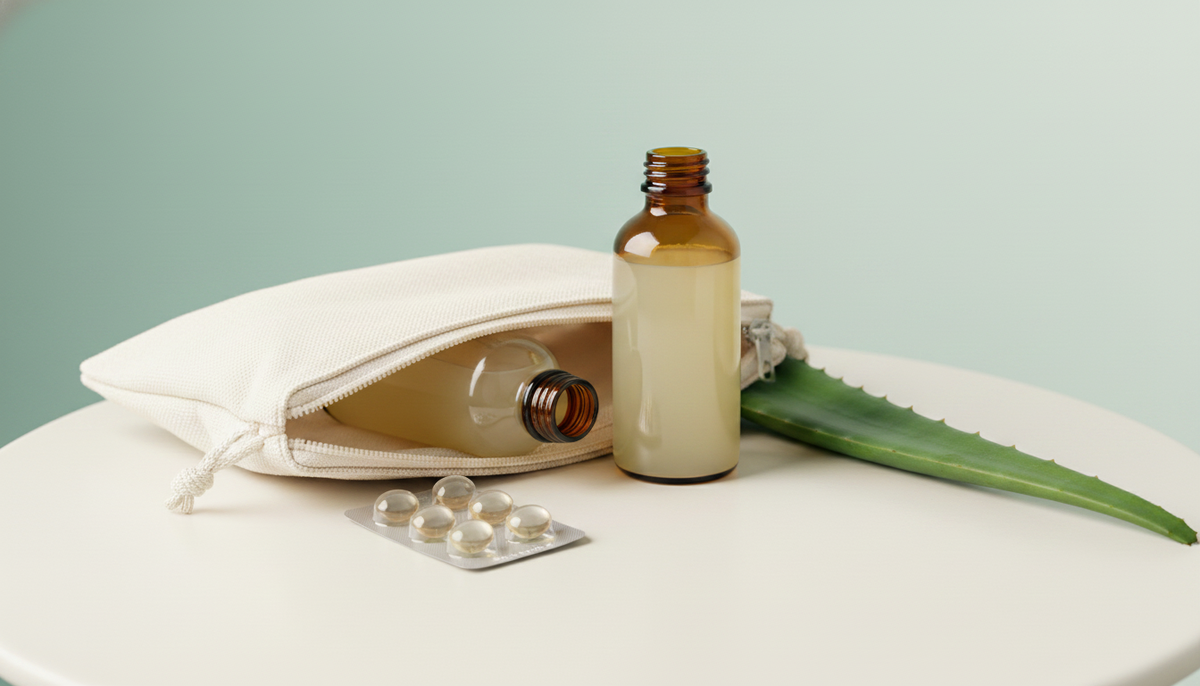
- "This is now part of my morning." Continue at the dose that worked. Consider switching to the 500ml format if you travel, or the aloe vera capsules as a travel backup.
- "I liked it but the bottle in the fridge was the friction." Switch to capsules as the primary format and keep the juice for occasional smoothies (see our smoothie recipes).
- "It was fine but I don't feel I need it daily." A 2-3 times-a-week routine is also valid. The polysaccharide content doesn't require daily intake to be useful.
- "It didn't fit my life." That's a legitimate outcome too. Wellness routines aren't one-size-fits-all.
Common questions
"Can I drink it with coffee?"
Not in the same 30 minutes. They're more pleasant separately. Most people land on aloe-juice first thing, coffee 30 minutes later with breakfast.
"Can I drink it with food?"
Yes. The traditional approach (and the one most people prefer) is on an empty stomach in the morning, but with food or after a meal also works. The body absorbs it either way.
"What if I miss a day?"
Pick up the routine the next day at the same dose. Don't double-dose. A consistent moderate intake beats spiky inconsistency every time.
"Should I cycle on and off?"
There's no compelling reason to cycle aloe juice (unlike some supplements where tolerance develops). If the routine works, continuing it indefinitely is fine.
"Can I take it with my medication?"
Aloe juice is a food and generally compatible with most medications, but if you take prescription drugs — especially anticoagulants, diabetes medications, or diuretics — check with your pharmacist or doctor before starting. The interaction risk is low but worth confirming for your specific situation.
"Will I lose weight on it?"
No. Aloe juice has minimal calories but it's not a weight-loss product. Weight loss requires a calorie deficit, which the juice neither causes nor prevents.
"Will my skin clear up?"
Don't expect aloe juice to change your skin. Skin concerns respond to a consistent topical routine suited to your skin type — see our skincare guides for the cosmetic side.
What to do at the end of 30 days
If the routine has earned its place in your morning, you're done with this guide — keep going. The 30-day frame was just a useful structure for the introduction phase. From here it's just "what you do in the morning."
If you've found that the daily intake matters to you but the bottle format is friction, the capsule format covers the same daily intake without needing the fridge or the glass.
If you found that 30 days was enough and it's not for you, that's completely fine. You ran the experiment honestly. The wellness routines that survive are the ones that fit your life — not the ones that fit someone else's marketing.
Things to skip during your 30 days
- Tracking elaborate "before and after" photos of yourself. The change, if any, will be too subtle for photos to capture meaningfully, and you'll set yourself up for disappointment.
- Compounding with five other new habits. If you start aloe juice, a new gym routine, intermittent fasting, and a meditation app all on day 1, you won't know which of them did what.
- Promising yourself a "cleanse" or "reset." Aloe juice isn't a cleanse. It's a daily juice. Lower the expectation, raise the consistency.
- Spending an hour on Instagram looking up "aloe juice transformations." Most of those are reconstituted-product marketing. Trust your own experience over influencer reviews.
FAQ
Is it dangerous to drink aloe juice daily?
For most healthy adults, properly produced inner-leaf aloe juice within recommended pour sizes is safe for daily long-term consumption. Pregnant women, breastfeeding women, people on certain medications, and people with chronic conditions should consult their healthcare provider first.
How much aloe juice is too much?
For most adults, the suggested serving is 30-60ml per day. Going above that is not recommended without specific guidance.
Does refrigeration affect the polysaccharide content?
No, properly stored (refrigerated after opening) aloe juice keeps well for up to 30 days after opening, as long as it stays in the fridge. Heat exposure and oxidation are the enemies, not cold.
What's the best time of day to drink it?
First thing in the morning is the most popular and the easiest to build a habit around. Any time works, though.
Can I do this with capsules instead of juice?
Yes. Take 1–2 capsules a day. The capsule format is functionally equivalent in terms of inner-leaf material delivered — what you lose is the juice ritual and the cold-drink mouthfeel.
Note: Curaloe products are food supplements, not medicines. If you are pregnant, breastfeeding, on prescription medication, or have a chronic condition, please consult your healthcare provider before adding any supplement to your routine. Information in this post is educational and not medical advice.
Related: Why Curaloe grows Aloe vera (Aloe barbadensis Miller), not Aloe ferox →

Leave a comment
This site is protected by hCaptcha and the hCaptcha Privacy Policy and Terms of Service apply.