
Cold-Pressed vs Reconstituted Aloe Juice: The Production Question That Decides Quality
If you stripped marketing from the aloe juice aisle and printed only the production method on each bottle, the category would look very different. Most "aloe vera juice" sold in South Africa isn't pressed from leaves at all. It's reconstituted — made by mixing imported aloe powder or concentrate with water in a factory that has never seen a live aloe plant.
This isn't fraud. It's standard industry practice and it's legal. But it produces a fundamentally different product from the cold-pressed inner-leaf juice that the premium end of the category is built on. The price gap reflects the production-cost gap. The nutritional gap is even larger.
This post explains what cold-pressing actually requires, what reconstitution does to the molecule that matters most (acemannan), and how to tell the two apart on a SA shelf. For the broader cluster, our pillar on Aloe Barbadensis science is the place to start.
What "cold-pressed" actually requires
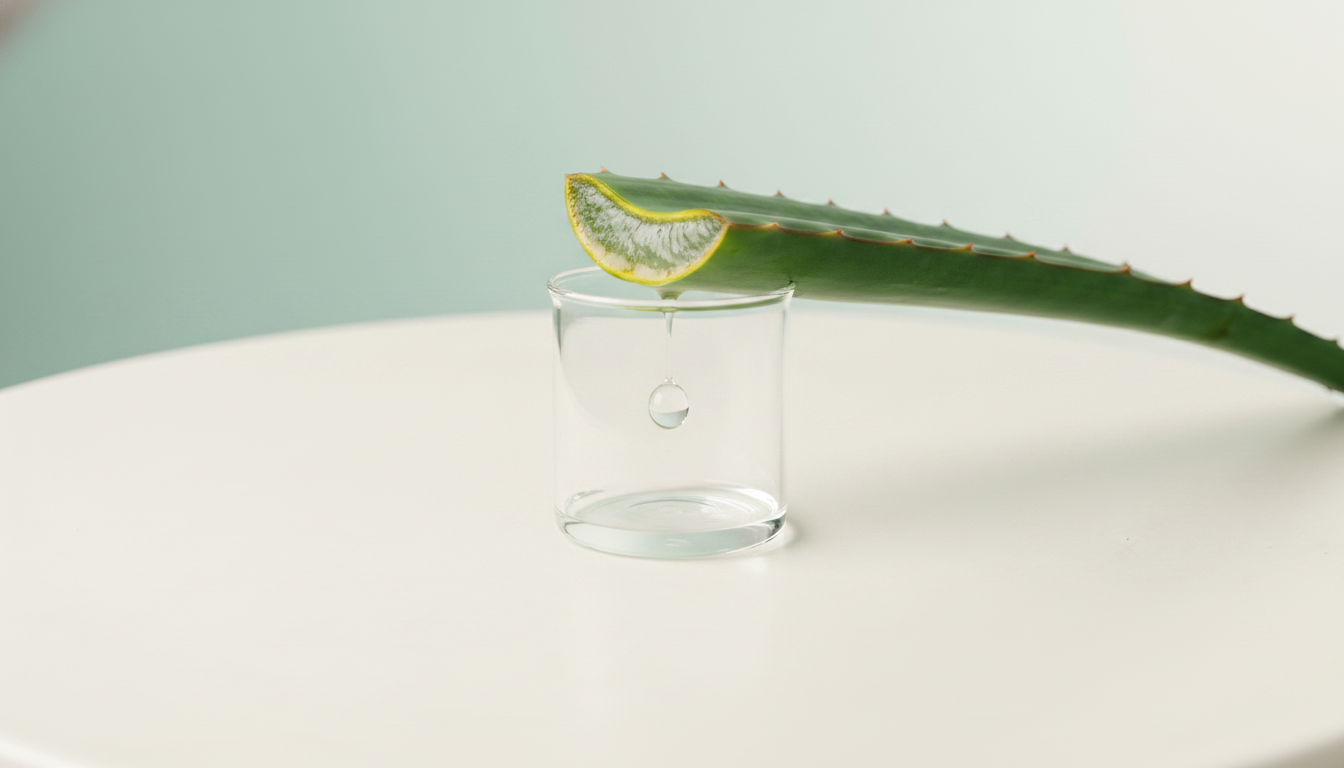
Cold-pressing is the production method where freshly cut aloe leaves are mechanically pressed at controlled low temperatures, without significant heat exposure, within a short window of harvest. The "cold" part refers to the absence of high-temperature pasteurisation or evaporative concentration.
Done properly, cold-pressing requires four conditions:
1. Proximity of farm to press
Aloe leaves start degrading the moment they're cut. Inner-leaf gel oxidises on contact with air. Polysaccharide chains begin fragmenting under enzymatic activity. Cold-pressing has to happen within hours of harvest — practically, that means the press needs to be on the same site as the farm, or very close to it.
If a "cold-pressed" product is bottled in a country that doesn't grow aloe (Northern Europe, the UK, most of Asia), the leaves had to travel a continent before pressing. The cold-pressing claim is, at best, technically true but functionally meaningless — the degradation already happened in transit.
2. Controlled temperature throughout
The whole pipeline — fillet, press, light decolourisation, bottling — has to operate at temperatures low enough to preserve the polysaccharide structure. High-temperature pasteurisation kills microbes but also breaks down acemannan. Reputable cold-pressed producers use low-temperature pasteurisation (or alternative microbial control approaches) that bring the juice to a safe state without thermal destruction of the actives.
3. Inner-leaf separation before pressing
Cold-pressing only realises its quality advantage when the rind and the latex-bearing layer are removed first. Pressing the whole leaf cold-produces a high-aloin slurry that then needs aggressive filtration — which removes the acemannan along with the aloin. Done right, cold-pressing is paired with inner-leaf filleting. Our decolourised vs whole-leaf post covers this in detail.
4. Time-to-bottle discipline
Same-day pressing matters; so does same-day bottling. A cold-pressed juice that sits in open tanks for three days before bottling has lost most of the advantage of being cold-pressed in the first place. The full pipeline — cut to sealed bottle — needs to be hours, not days.
The Curaloe ACAP plantation has all four conditions in place: farm and processing facility on the same site, controlled-temperature processing, inner-leaf filleting, and same-day bottling.
What reconstitution actually is
Reconstituted aloe vera juice is made by:
- Buying aloe powder or concentrated extract from a bulk supplier (usually a wholesaler with multiple-origin sourcing)
- Rehydrating the powder with water in a factory mixer
- Adding flavourings, sweeteners, or fruit juice as desired
- Adding preservatives for shelf stability
- Bottling and labelling as "aloe vera juice"
This is the dominant production method globally for the cheap end of the aloe juice market. It's industrially scalable, it has minimal capital requirements (no farm, no field operations, no time-pressure pipeline), and it produces a shelf-stable product that can be made in any food-grade facility anywhere in the world.
The catch: the aloe powder being reconstituted has already lost most of what made the original juice valuable.
What happens to acemannan during the powder cycle
Acemannan is a long-chain polysaccharide. Long polysaccharide chains do not survive industrial drying processes intact. The typical journey of bulk aloe powder:
- Fresh juice extracted at the farm (in Mexico, India, China, or wherever the supplier is based) — polysaccharides intact
- Concentrated by evaporation to reduce volume for transport — heat damages polysaccharides
- Spray-dried at temperatures around 150-180°C inlet, 60-80°C outlet — major polysaccharide fragmentation
- Stored as powder for weeks to months — ongoing slow degradation
- Shipped internationally — temperature exposure, time
- Rehydrated in receiving country — water added back, but the polysaccharides are already fragmented
- Bottled and labelled as "aloe vera juice"
The product on the SA shelf at the end of this chain may still contain "aloe vera juice" on the ingredient list, and it may even be 99% by volume — but the long-chain acemannan content is a fraction of what fresh cold-pressed juice contains. The cell-wall vitamins and minerals have similar fates.
We unpack the acemannan side specifically in our acemannan post.
Why the SA market is full of reconstituted product
Several converging reasons:
- Imported aloe powder is cheap. Wholesale aloe powder from Mexico or India costs a fraction of what cold-pressing locally costs.
- Low capital barrier. A SA company can bottle "aloe juice" without owning a farm or running a processing facility. A food-grade mixer and a bottling line is enough.
- No regulatory requirement to disclose method. "Reconstituted from concentrate" doesn't have to appear on the label. The product can be sold simply as "aloe vera juice."
- Most consumers don't know the difference. The juice looks the same in the bottle. The flavour profile can be tweaked with adjuncts. Marketing fills the gap.
- Local aloe-growing capacity is limited. A fully integrated SA Aloe barbadensis operation like the ACAP plantation is the exception, not the rule. Most SA aloe brands don't own the upstream agriculture.
This is why the 7-point label guide matters — the marketing layer hides the production reality, but the label has tells.
How to tell from the label
Reconstituted juice rarely says so explicitly. The tells are circumstantial:
Country of manufacture vs country of aloe origin
- If the label says "Manufactured in [country with no aloe agriculture]" and doesn't list a separate aloe-growing country, the aloe was almost certainly imported as powder.
- If the label is silent on origin entirely, default to assuming reconstituted.
- If the label specifies a growing region and a farm name, you're looking at a more vertically integrated operation.
Ingredient list specificity
- Reconstituted products often list "aloe vera juice" without specifying inner-leaf, processing method, or species in Latin.
- Cold-pressed inner-leaf products typically specify all three because the producer has them to specify.
Long ingredient list with sweeteners
- Reconstituted aloe juice often has added sweeteners (sugar, glucose syrup, sucralose) to make up for the loss of the polysaccharide texture that contributes to fresh juice's mouthfeel. A long ingredient list is correlated with reconstitution.
- A clean two- or three-ingredient list (juice + citric acid, optionally a second preservative) is correlated with cold-pressed.
Price
- Reconstituted juice usually retails at R30-R80 per litre.
- Cold-pressed inner-leaf single-species juice usually retails at R180-R350 per litre.
- The price gap reflects the production-cost gap. There's no magic discount path between the two — the cheaper product is cheaper because it's made by a fundamentally cheaper process.
Cold-pressed is not just "better marketing"
It's worth being explicit about why the gap matters in practice:
- Polysaccharide content. Cold-pressed inner-leaf juice retains the long-chain polysaccharides (acemannan and related compounds) that fresh aloe leaves contain. Reconstituted juice does not, to any meaningful extent.
- Vitamin and mineral content. The water-soluble vitamins (B-complex, C) and the trace minerals are partially preserved in cold-pressing but degraded heavily in the drying-concentration-rehydration cycle.
- Enzyme content. Fresh juice contains naturally-occurring enzymes that survive cold-pressing but not industrial drying.
- Mouthfeel and taste. Cold-pressed juice has a slightly viscous body and a clean, mild grassy flavour. Reconstituted juice is typically thinner, often masked with sweeteners or fruit juice to compensate for the flatter base.
If you only ever drink reconstituted aloe juice, that's the bar you're calibrated to. Switching to a real cold-pressed juice is noticeable — the difference is most obvious in the texture and aftertaste.
What about freeze-dried aloe (e.g. in capsules)?
Freeze-drying is a separate category from spray-drying or evaporative concentration. Done at very low temperatures and under vacuum, freeze-drying preserves polysaccharide structure far better than the hot-drying methods used for bulk powder.
Our aloe vera capsules use freeze-dried inner-leaf material from the same ACAP plantation that supplies our juice. This is functionally a way of carrying real cold-pressed-quality aloe in a stable, travel-friendly format — not a reconstituted analogue.
When reconstituted is fine, and when it isn't
We're not arguing reconstituted aloe juice has no use. As a flavour ingredient in a drink, as a cosmetic raw material, or as a budget option for someone who specifically wants the bitter-tonic effect (some reconstituted products are made from whole-leaf with significant aloin remaining), it has a place.
What it isn't is interchangeable with cold-pressed inner-leaf juice. The two are different categories of product and should be priced and used differently.
For people choosing aloe juice as part of a daily wellness ritual where the polysaccharide content is part of what they're paying for, reconstituted falls short. Our daily routine guide assumes the cold-pressed version because that's the version that delivers the nutritional profile the ritual is built around.
What Curaloe does
Every Curaloe juice — 1L Health Boost and 500ml Wellness Boost — is cold-pressed at the ACAP plantation in Limpopo within hours of harvest. Inner-leaf only. Single species (Aloe barbadensis Miller). Light decolourisation. Bottled same day.
This is also why our pricing isn't comparable to a reconstituted supermarket product. We can't be — we're making a different category of thing.
FAQ
Is reconstituted aloe juice unsafe?
Generally no — if it meets the 10 ppm aloin regulatory limit and uses standard food-grade preservatives, it's safe to drink. It's just nutritionally weaker than cold-pressed inner-leaf juice.
Can you tell from the colour?
Not reliably. Both cold-pressed and reconstituted juice can be clear or pale-yellow. Reconstituted with added colour (yellow or green dye) is a flag, but colour absence doesn't prove cold-pressing.
Is "from concentrate" the same as reconstituted?
Effectively, yes. Concentrate is what spray-dried powder or evaporated extract becomes after rehydration. The labels often avoid both terms.
How long does cold-pressed juice keep?
A well-pasteurised cold-pressed aloe juice with food-grade preservatives can keep 12-18 months unopened at room temperature. Refrigerate after opening and use within 4-6 weeks.
Why don't more SA producers cold-press locally?
Because it requires owning agricultural land, running a farm operation, and building a same-site processing facility. It's a multi-million-rand capital commitment that takes 3-4 years (the propagation cycle of mature plants) before the first commercial harvest. Reconstitution is one-tenth the capital and starts producing immediately.
Note: Curaloe products are food supplements, not medicines. If you are pregnant, breastfeeding, on prescription medication, or have a chronic condition, please consult your healthcare provider before adding any supplement to your routine. Information in this post is educational and not medical advice.
Related: Why Curaloe grows Aloe vera (Aloe barbadensis Miller), not Aloe ferox →


Leave a comment
This site is protected by hCaptcha and the hCaptcha Privacy Policy and Terms of Service apply.