

Sustainability at the ACAP Plantation: Water, Soil, People
"Sustainable" is one of the most overused words in consumer packaging. It usually means a brand has made one or two operational choices that fit a sustainability narrative — a recycled bottle, a tree-planting partnership, a carbon-offset purchase — without engaging with the harder structural questions about how the product is actually made.
This post is an attempt to be specific instead. It covers what sustainability looks like at the ACAP plantation at Iphofolo Game Farm in Vivo, Limpopo Province — the working farm where every Curaloe leaf is grown, harvested, and pressed — across three dimensions that we think matter most: water, soil, and people. It also names the trade-offs and limitations honestly, because a credible sustainability claim needs to.
For the farm tour and the operational basics, see Inside the ACAP Plantation. For the brand origin and the broader story, our Curaloe origin pillar is the place to start.
Water — the most important question on an Limpopo farm
The Limpopo's water situation matters. The province has gone through multiple drought cycles in recent years. Municipal water supply has been intermittent in some areas. Any agricultural operation in this region has to take water seriously or it isn't really operating in good faith.
Why aloe is a water-efficient crop to start with
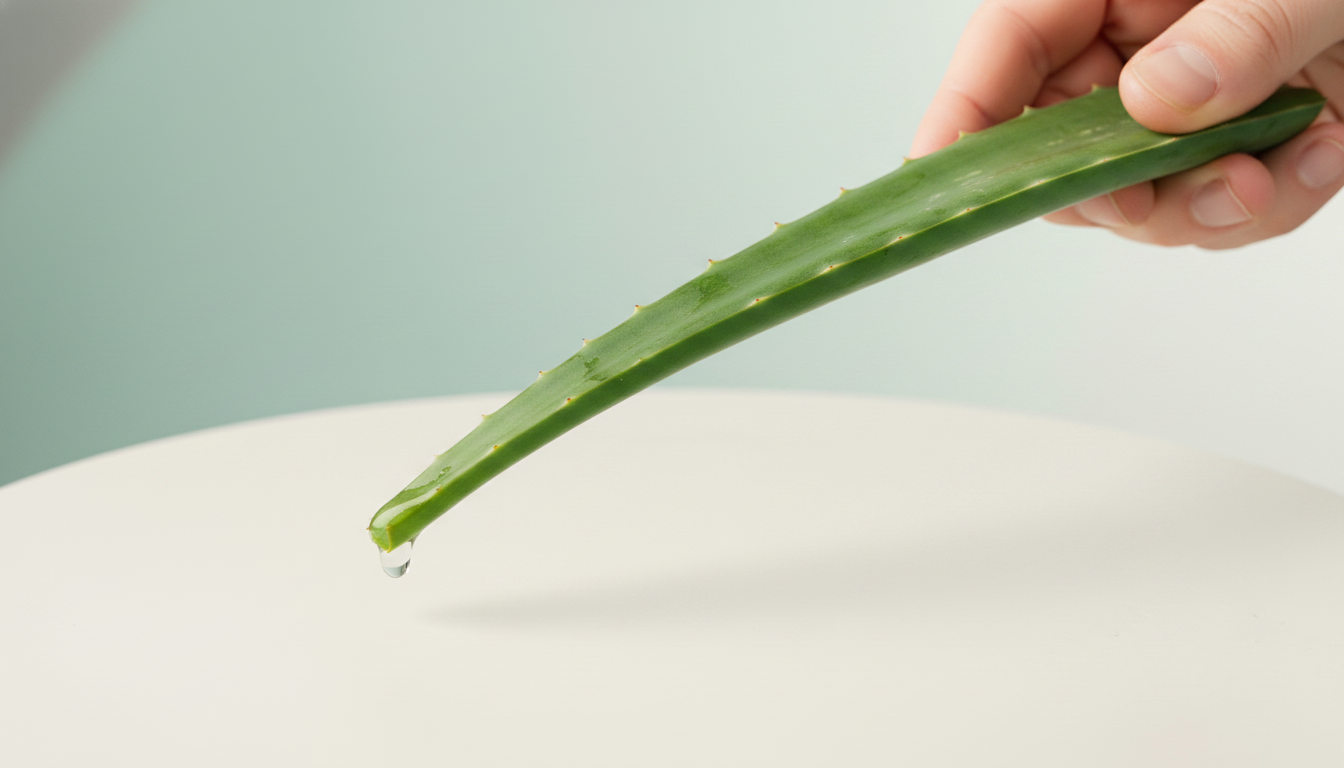
Aloe barbadensis Miller is a succulent. It evolved in arid to subtropical bushveld environments. Its physiology is built around storing water in fleshy leaves rather than constantly consuming new water from the soil. Compared to almost any common commercial crop — maize, sugarcane, citrus, vegetables — aloe needs a fraction of the irrigation to produce a fraction of the biomass.
Concretely: a hectare of aloe in our growing conditions typically needs a small fraction of the irrigation water that a hectare of maize would need in the same region. Aloe is one of the genuinely water-light commercial crops you can grow in this part of South Africa.
What we actually do on water
- Drip irrigation only. No flood irrigation, no overhead sprinklers, no evaporative losses to wind and sun. Water is delivered directly to root zones.
- Soil-moisture sensor scheduling. Irrigation runs are triggered by actual soil moisture readings, not by calendar schedule. Many days of the year there's no irrigation at all.
- Rainwater capture from the processing facility roof surfaces, used for non-potable site needs.
- Deficit irrigation strategy. We deliberately keep the plants in mild controlled water stress for parts of the year, both because it produces denser polysaccharide-rich inner gel (water-stressed aloe is better aloe) and because it reduces total water use.
Where we don't pretend
We do use municipal and borehole water for the irrigation that the plants do need. We're not claiming a zero-water operation — that's not possible for a farming business. What we can claim is that water use per litre of finished juice is materially lower than for most agricultural products, and that our irrigation discipline is built around the regional reality.
For context, the water embedded in producing a litre of cold-pressed aloe juice is far lower than the embedded water in producing a litre of fruit juice from the same region — partly because aloe needs less, partly because we don't dilute with added water in production.
Soil — the long game
Soil sustainability on an aloe plantation has a different texture than on row-crop farms. Aloe is a long-lived perennial. The same plants in the same field block stay in place for 10-12 years before being rotated out. This makes soil management both more important (you can't fix bad soil decisions by changing the crop next season) and easier (you're not turning soil over annually).
What we do on soil
- No synthetic herbicides. Weed control is mechanical and hand-pulled. This is labour-intensive but keeps the soil microbial community intact and avoids residual herbicide breakdown products.
- Minimal synthetic fertiliser. Aloe is a low-nutrient-demand crop. We use targeted micronutrient amendments where soil tests show deficiency, but no broad NPK application.
- Composted organic matter from the processing facility (rind and latex offcuts that don't go into juice) returns to the field as compost. This closes a loop that most aloe operations leave open.
- Cover crops between field blocks where appropriate, to hold soil structure and prevent erosion during off-rotation periods.
- No-till transplanting when establishing new field blocks, preserving the existing soil profile.
- Soil testing annually with adjustments based on the actual chemistry, not assumed needs.
Certification, and what we don't claim
We are certified organic: the plantation is certified by Ecocert to both the USDA National Organic Program (NOP) and EU organic standards, covering the cultivated Aloe barbadensis Miller and our processed aloe. Independent batch testing for residues is also part of our regular QC.
We also don't claim to be carbon-negative or carbon-neutral. We are, like every farming operation, a net energy user. We manage what we manage well and don't oversell.
People — labour, wages, and community
The most under-discussed part of agricultural sustainability is the human side. A "sustainable" farm that pays sub-minimum wages, uses casual labour without protections, or operates in a way that fails the surrounding community isn't sustainable in any meaningful sense.
What we do on people
- Permanent core team year-round. Field workers, processing-facility staff, QC, admin, and management are all on permanent employment contracts with benefits, not seasonal day-labour.
- Seasonal harvest workers during peak cycles are paid above agricultural minimum wage with structured contracts. We track returnee rates as a quality signal — workers who keep coming back are workers who are being treated reasonably.
- On-site healthcare access in the form of clinic visits and basic first-aid capacity. The nearest medical facilities are not always close; we've invested in onsite capacity to bridge.
- Skills development. Field workers are trained in identification, harvest cuts, and basic plant health. Processing-facility staff are trained on food-safety standards. This is partly investment in the operation and partly investment in employability beyond Curaloe.
- No child labour. Standard for any food-safety-certified operation but worth saying explicitly.
- Local hiring priority. The plantation is in a part of Limpopo Province where employment options are limited. Hiring locally is both the right thing to do and the practical thing — the workforce has continuity, knowledge of the conditions, and a stake in the operation's success.
What we're working on
We're not perfect on this dimension. Specific things we're improving:
- Worker housing for permanent seasonal returners during peak season — the local accommodation infrastructure is limited.
- Educational support for workers' families — a pilot bursary scheme is running for two children of long-tenure staff this year, which we'd like to scale.
- Transparency on wage data. We publish wage ranges to wholesale partners on request; we're moving toward publishing them publicly.
This is the honest version of "we care about people." It includes the work that's done, the work that's ongoing, and the gaps we know about.
Packaging — the trade-offs we make
Packaging is the most visible sustainability dimension and arguably one of the harder ones to optimise honestly. For our 1L aloe juice bottle, the considerations are:
- Glass vs PET vs HDPE. Glass is the most recycled material in SA but it's also the heaviest (higher shipping CO₂) and most fragile (higher breakage waste). PET is light and widely recycled but it's plastic. HDPE is durable but harder to recycle locally.
- Recycled content vs virgin material. We use a meaningful percentage of recycled content in our PET bottles where the food-safety regulations allow it.
- Bottle size and packaging efficiency. A 1L bottle has a better contents-to-packaging ratio than a 500ml bottle — but the 500ml travel size serves a real use case that the 1L doesn't.
- Label and adhesive choices that don't interfere with recyclability.
We don't pretend we've solved this. Every packaging choice has trade-offs. We pick the option that's best for the specific use case rather than picking one "sustainable" packaging approach and applying it universally.
Transport and energy
For domestic SA orders, our juice typically travels from Limpopo Province to the consumer's province by domestic logistics — a short supply chain compared to imported aloe products. For our limited international export, we batch consolidate to reduce per-bottle transport footprint.
The on-site processing facility uses grid electricity supplemented with rooftop solar for daytime processing. We're not off-grid and we don't claim to be, but the solar contribution is real and growing.
What sustainability isn't, in our view
A few claims you won't see us make:
- ❌ "100% sustainable" — meaningless without a defined standard
- ❌ "Carbon-neutral" — true carbon neutrality for an agricultural operation requires expensive offsets that we judge to be questionable value
- ❌ "Zero-waste" — not literally true for any food operation
- ❌ "Saves the planet" — overclaim, dilutes the meaning of any genuine effort
Instead, we'd rather be specific about what we actually do, what trade-offs we make, and what we're still working on. That's the standard we hold ourselves to.
Why this matters to what's in your bottle
Sustainability isn't a separate marketing dimension — it's downstream of how the product is made. Hand-pulled weed control means no herbicide residue testing. Composted-back rind and latex means a closed-loop processing facility. Permanent skilled labour means consistent harvest quality. Drip irrigation and deficit watering means denser polysaccharide-rich inner gel.
The choices that make the operation sustainable are largely the same choices that make the juice itself better. They cost more, but they're the only way to make the quality claim real.
FAQ
Are you organic-certified?
Yes. The plantation is certified organic by Ecocert, to both the USDA National Organic Program (NOP) and EU organic standards. Independent residue testing is also part of our regular QC.
What's your carbon footprint?
We don't publish a formal LCA number because we don't trust the precision of those calculations for an operation our size. We can describe the inputs (electricity mix, transport miles, packaging materials) and let buyers form their own view.
Do you donate to environmental causes?
We don't run a formal donation programme. We'd rather invest in the operation itself — better worker conditions, better field practices, better packaging.
What about plastic in your packaging?
PET bottles where used contain recycled content. We're evaluating glass options for the 500ml line and have not yet committed because the trade-offs (weight, breakage, shipping emissions) aren't obviously better.
How do you verify wage and labour claims?
Wholesale partners can request wage data and labour-practice documentation directly. We're working toward public disclosure.
Note: Curaloe products are food supplements and topical cosmetics, not medicines. Information in this post is educational and reflects our farming and operational practices.
Related: Why Curaloe grows Aloe vera (Aloe barbadensis Miller), not Aloe ferox →


Leave a comment
This site is protected by hCaptcha and the hCaptcha Privacy Policy and Terms of Service apply.