
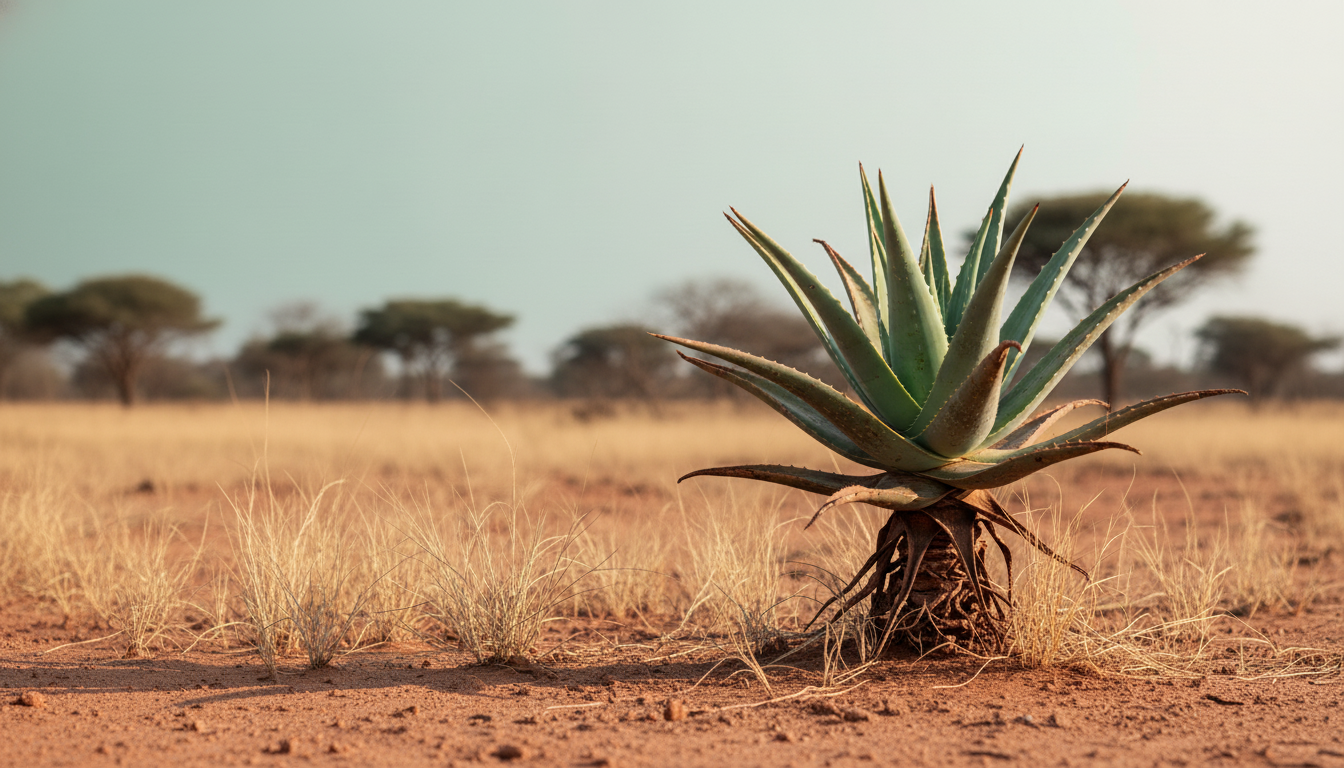
Why South African-Grown Aloe Matters for Quality (and Why Limpopo Specifically)
Aloe vera is grown commercially on every continent except Antarctica. Mexico, the southern US (Texas, Arizona, Florida), India, China, Spain, Brazil and the Dominican Republic are all significant producers. Most of the bulk aloe powder traded on world commodity markets comes from those origins.
South Africa is a minor player by global volume — but for a very specific subset of the aloe market (single-species, cold-pressed inner-leaf juice with intact polysaccharides), Limpopo Province is one of the best growing locations in the world. This post explains why, and what that means for the juice you actually pour.
For the broader brand context, our Curaloe origin story pillar covers the founder journey from Curaçao to the Limpopo. For a detailed look at the ACAP farm itself, see Inside the ACAP Plantation.
What Aloe barbadensis Miller actually wants
The plant's evolutionary preferences are fairly specific:
- Mild winters (no hard frost; the plant tolerates brief light cold but suffers cell damage below -1°C)
- Long warm dry summers with high diurnal variation (warm days, cooler nights)
- Well-drained, mineral-rich sandy loam (the plant rots in heavy clay or waterlogged ground)
- High UV exposure (drives polysaccharide accumulation in the inner gel as part of the plant's water-storage strategy)
- Low organic matter in soil (high-organic soils encourage fast watery growth, not dense gel)
When you tick all five of those boxes, you get a plant that produces thick, heavy leaves with dense inner gel high in long-chain polysaccharides like acemannan. When you don't tick them, you get plants that survive — aloe is hardy — but produce thinner, more watery flesh.
The northern Limpopo bushveld, at the base of the Soutpansberg mountain range, — happens to tick all five.
Why Limpopo Province specifically
Climate fit
The Limpopo's interior runs through a subtropical bushveld climate, with:
- Mild winters (overnight lows rarely below 2-3°C; daytime highs typically 18-22°C even in July)
- Long dry summers (December-March daytime highs 28-35°C, nights cooling to 14-18°C)
- A natural diurnal swing of 12-18°C between day and night for most of the growing season
- A rainfall pattern with most precipitation falling outside the peak growing months, giving the plants the long dry stretches they prefer
This profile is comparable to parts of southern Mexico and the Mediterranean — both well-known aloe growing regions — but with the added advantage of no genuine winter dormancy. The Limpopo lets aloe grow productively all twelve months.
Soil chemistry
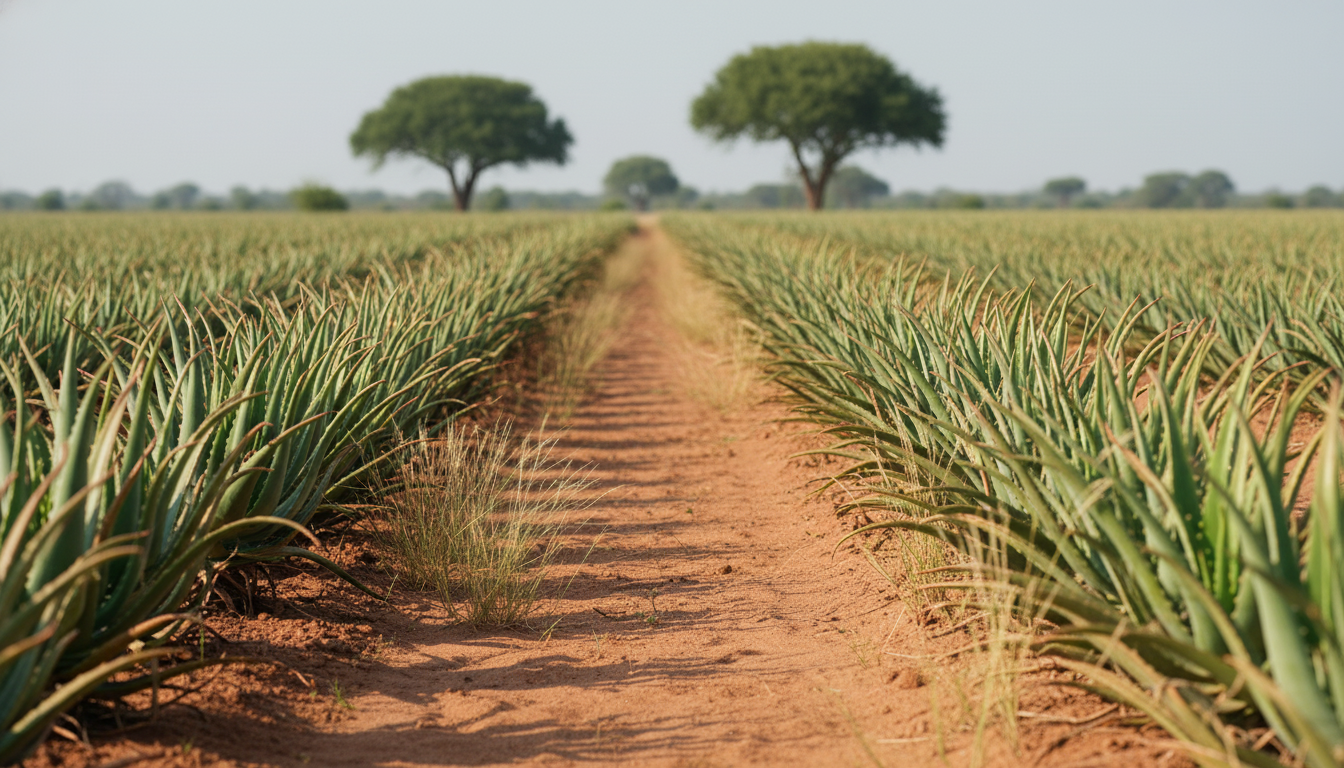
The Limpopo-edge soils at the ACAP plantation are naturally:
- Low in organic matter (favours slow dense growth over fast watery growth)
- Mineral-rich, especially calcium, magnesium and iron
- Well-drained sandy-loam structure (no waterlogging risk)
- Moderately acidic to near-neutral (typical of the western Soutpansberg sandy loam)
You can replicate some of this with soil amendments elsewhere, but the natural starting point matters because it shapes how the plant has to allocate its energy. Aloe in marginal soil spends more on root development and less on inner-gel synthesis. Aloe in well-matched soil puts more biomass into the part of the plant that actually goes into the bottle.
UV exposure and altitude
The Soutpansberg region sits at moderate altitude (800-1,400m for the aloe-growing zone). UV is strong without being extreme. This drives polysaccharide accumulation in the inner gel — the plant's response to UV stress is to thicken its water-storage tissues with the very compounds (including acemannan) that make the juice nutritionally interesting.
We unpack the molecular side of this in our acemannan post.
No frost concerns
Frost is the single biggest constraint on commercial Aloe barbadensis production globally. In Texas and Spain, occasional winter frosts kill entire field blocks every few years. In the western Soutpansberg around the ACAP plantation in Vivo, hard frost is rare — typically only a handful of days per year, and the location was chosen partly for this favourable winter profile. Plants accumulate biomass uninterrupted across what would be the dormant or damaged season elsewhere.
Why South African origin matters for the SA buyer specifically
If you live in South Africa, buying a South African-grown aloe juice isn't just about food miles — it has direct quality implications:
1. Shorter supply chain = fresher product
The leaves are cut, processed and bottled at the same Limpopo site, then shipped to your city via domestic logistics — typically arriving within days, not the weeks-to-months involved in importing from Mexico or India. Fresher juice = better polysaccharide preservation.
2. No reconstitution risk
Most cheap "aloe vera juice" sold in SA is reconstituted from imported aloe powder. The powder travels well; fresh juice doesn't. A producer that grows and presses locally has no need to reconstitute — you're drinking juice that's never been a powder. We cover this in detail in Cold-Pressed vs Reconstituted.
3. Traceable supply chain
A local farm can answer specific questions: which field block was your batch harvested from, what date, what was the weather that week. Imported powder can only answer "we bought it from a wholesaler in [country]."
4. Supports local agricultural employment
The ACAP plantation employs a permanent core team and seasonal harvest workers from the surrounding Limpopo communities. Importing aloe from Mexico contributes to Mexican rural employment; growing it locally contributes to ours. This isn't the most important factor for most buyers but it matters to many. Our sustainability post covers this dimension.
5. Easier regulatory compliance
Locally grown means locally tested. South African food safety regulations apply directly. Imported aloe products technically meet the same regulations on arrival, but the verification trail is longer and less direct.
What South African-grown aloe is not automatically
It's worth being precise: "South African-grown" is not by itself a guarantee of quality. The country produces both:
- *Inner-leaf cold-pressed Aloe barbadensis juice* (the premium category — what we make)
- *Indigenous Aloe ferox extracts* (a completely different species, traditionally used as a bitter laxative)
- Reconstituted "South African" aloe (made in SA from imported powder — uses the country name without growing the plants here)
A South African address on the label tells you the bottle was filled here. It doesn't automatically tell you the plants were grown here. The label has to specify the farm or growing region for that claim to mean anything.
This is one of the reasons we name the ACAP plantation explicitly. "Grown at our farm in Limpopo Province" is a verifiable claim. "South African product" is a much softer one.
Comparing the major aloe origins (for context)
| Origin | Climate fit | Production scale | Typical use |
|---|---|---|---|
| Mexico | Excellent | Largest global producer | Bulk powder, bottled juice, cosmetic ingredients |
| Southern USA (Texas, Florida) | Good but frost-vulnerable | Mid-tier | Bottled juice, cosmetic |
| India | Good | Large | Bulk powder, traditional medicine, cosmetic |
| Spain | Good | Mid-tier | Cosmetic, premium juice |
| China | Variable | Large | Bulk powder, ingredients |
| South Africa (Limpopo barbadensis) | Excellent | Small | Premium single-species juice |
| South Africa (Western/Limpopo ferox) | Native habitat | Mid-tier | Traditional bitter products |
Notice the size difference. SA-grown Aloe barbadensis is a small slice of global production. That's part of what makes it a quality-focused category by default — the producers can't compete on bulk volume, so they compete on the specifics.
What "grown in South Africa" should mean on a label
A label that's making a real claim about local growing will include:
- The species name (Aloe barbadensis Miller, not just "aloe vera")
- A specific region (Limpopo, not just "South Africa")
- Ideally a farm name (e.g., "ACAP plantation")
- A production method consistent with local growing (cold-pressed within hours of harvest, not "made in South Africa from imported concentrate")
If a label says "made in South Africa" but is silent on where the actual aloe was grown, treat it as likely reconstituted from imported material. The producer would mention it if it were grown here.
For the broader label checklist, see our 7-point label guide.
What you're paying for when you choose SA-grown
When you choose a Curaloe 1L juice, the South African origin contributes specifically to:
- Freshness in the bottle (days from press to dispatch, not months)
- Single-species certainty (the field blocks are Aloe barbadensis only; no risk of Aloe ferox contamination from local wild material)
- Traceability (any bottle can be traced back to a specific harvest batch and field block)
- Climate-driven polysaccharide density (Limpopo UV + diurnal swing drives high acemannan content)
- Local supply chain accountability (you can ask us where your batch came from and get a real answer)
For the same material in a more concentrated daily-use format, our aloe vera capsules use the same ACAP-grown inner-leaf juice in freeze-dried form.
FAQ
Is South African aloe better than Mexican aloe?
For single-species cold-pressed inner-leaf juice, the SA Limpopo category is excellent. For bulk commodity powder, Mexico has scale and competitive pricing advantages. They serve different parts of the market.
Does the Western Cape grow aloe too?
Some, but the Western Cape's wetter winters and frost risk in inland areas make it less ideal for commercial Aloe barbadensis. The Western Cape is more associated with indigenous Aloe ferox (which is well-adapted to that region).
What about KwaZulu-Natal?
KZN's higher humidity is less ideal for the polysaccharide-density profile that Limpopo produces. Aloe will grow there, but the inner gel tends to be more watery and lower in long-chain polysaccharides.
Is altitude important?
Moderately. The Limpopo's 400-1,200m range provides enough UV exposure to drive polysaccharide accumulation without the extreme conditions of much higher altitudes that can stress the plants.
How do you handle the dry years?
The plants are drought-tolerant by nature, and we irrigate to keep them alive without pushing them into fast-growth mode. Drought years actually produce slightly more polysaccharide-dense leaves; flood years produce more leaf volume but slightly thinner gel.
Note: Curaloe products are food supplements, not medicines. If you are pregnant, breastfeeding, on prescription medication, or have a chronic condition, please consult your healthcare provider before adding any supplement to your routine. Information in this post is educational and not medical advice.
Related: Why Curaloe grows Aloe vera (Aloe barbadensis Miller), not Aloe ferox →
,%20India,%20China,%20Spain,%20Brazil%20and%20the%20Dominican%20Republic%20are%20all%20significant%20p...)
Leave a comment
This site is protected by hCaptcha and the hCaptcha Privacy Policy and Terms of Service apply.