
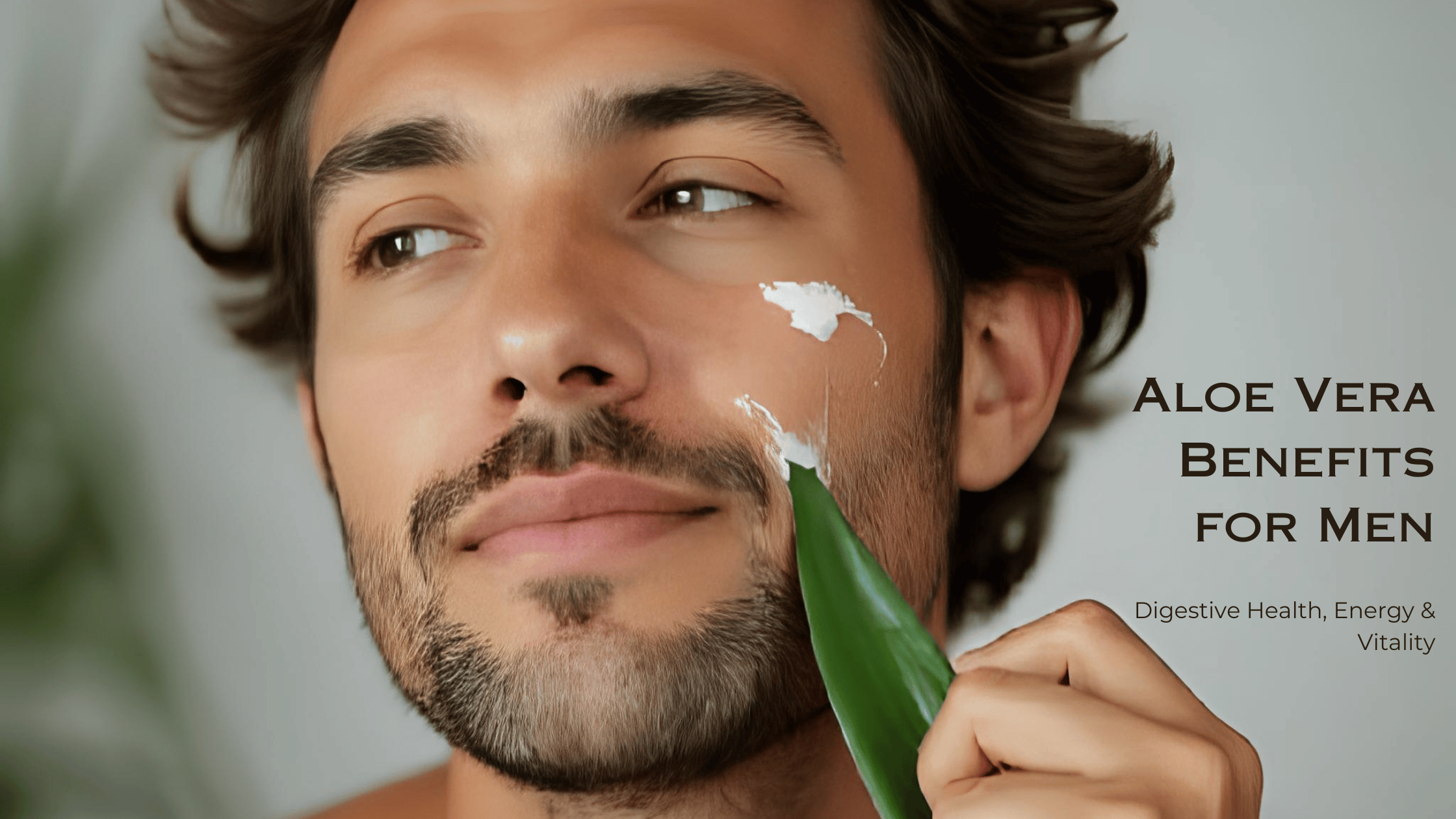
Aloe Juice in Men's Daily Wellness Rituals: A No-Hype Guide
The wellness industry tends to talk to men in one of two registers: either as a sub-category of "general consumers" (with marketing copy that was originally written for women and lightly recoloured), or with aggressive performance-and-physique angles that promise dramatic results from this-one-supplement.
Neither is particularly useful for the everyday SA man — the guy who's trying to drink more water, sleep enough, eat reasonably, and feel decent at 45 without making it into a personality. This post is written for that audience. It looks at where a daily aloe juice routine fits in a real man's morning, what makes it sustainable, and how to think about it without overpromising what it does.
For the broader daily routine framework, see our Daily Aloe Juice Ritual guide. For the skincare side specifically, our Men's 3-Product Aloe Skincare Routine is the complementary post.
Why "men's wellness" is a worse marketing category than it sounds
A lot of "men's wellness" product marketing leans on three things: testosterone, muscle, and sexual function. These are real biological topics, but they're also categories where the consumer-product industry has consistently overpromised and underdelivered. A daily juice — any daily juice — doesn't move the needle on these meaningfully. Marketing that suggests otherwise should be treated with suspicion.
A more useful framing for the everyday SA man:
- Energy through the workday is mostly downstream of sleep, food, hydration, and movement. Daily juice is a supportive role, not a driver.
- Long-term metabolic health is mostly downstream of diet, exercise, body composition, and stress management over years. No single drink changes the trajectory.
- Subjective wellbeing — feeling steady, not foggy, not bloated, not crashing at 3pm — is the cumulative result of many small daily habits. Daily juice is one of the easier small habits to add.
That last category is where a daily aloe juice routine actually earns its place. Not as a performance enhancer, not as a hormone modulator, not as a sexual-function product — but as a small consistent habit that contributes to subjective wellbeing alongside everything else.
What a real man's morning routine looks like
There's a lot of online content about "the ideal morning routine" that runs 90 minutes and includes ice baths, journaling, breathwork, sun gazing, and a green smoothie made of seven ingredients you've never heard of. Most working men, with kids, mortgages, and an 8am meeting, don't have that morning available to them.
A more realistic morning that includes aloe juice:
Workday version (15-20 minutes)
- Wake up. Don't reach for your phone.
- Glass of water + 30-60ml of Curaloe Aloe Vera Juice while the kettle boils. Takes 60 seconds.
- Shower, get dressed, brush teeth. Standard.
- Coffee + something resembling breakfast while you check the day's calendar. Real food beats none.
- Leave the house with a refillable water bottle that you'll actually use.
That's it. The aloe juice slots in at step 2 as the pre-coffee morning drink. It takes one pour, no preparation, no recipe, no blender. Drink, move on with your day.
Weekend version (more flexibility)
Same as above, but you might:
- Have your aloe juice in a more elaborate format — try one of the smoothie recipes at the weekend when you have time for a blender.
- Pair the morning routine with a longer walk, a real cooked breakfast, or a gym session.
- Use the routine as anchor for catching up on water intake before the day gets busy.
The point isn't that the weekend version is better — it's that the same daily juice habit slots into both versions without effort.
Why aloe juice fits the "minimal effort" criterion
A few reasons it tends to stick as a routine where other "men's health" products don't:
1. It's already a drink
You're already drinking something in the morning (coffee, water, juice, energy drink). Replacing or supplementing one of those with aloe juice doesn't require adding a new behaviour — it modifies an existing one. That's the lowest-friction kind of habit change.
2. It takes 60 seconds
No measuring, no mixing, no preparation. Pour from bottle, drink. It's easy to keep up even on your worst morning.
3. The taste is neutral
Inner-leaf aloe juice has a mild, earthy flavour. It's not a "tough drink" you have to power through (looking at you, apple-cider-vinegar shots). Most people get used to the taste quickly.
4. It scales with your schedule
You can do 30ml on a rushed morning or 60ml as part of a more deliberate routine. There's no "you must take exactly this dose at this time" rigidity that makes daily supplements painful.
5. It's not a status play
Aloe juice isn't trendy. It's not on Instagram. Nobody's going to ask you about your "aloe protocol." For a lot of men, that's a feature, not a bug — it's a private personal habit, not a personality.
What it can plausibly contribute (and what it can't)
Honest list of contributions for the everyday SA man:
- A consistent morning hydration anchor. Starting the day with a glass of water + aloe juice means you've had ~250ml of fluid before you walk out the door. Most men don't do this.
- Inner-leaf polysaccharides (acemannan and related) as part of a varied diet — see our acemannan post for the molecular side.
- A low-sugar morning drink that might replace a sugary fruit juice, a sweetened breakfast smoothie, or a soda.
- A small daily ritual that may anchor other healthy choices.
Things it does not do:
- Boost testosterone
- Improve sexual performance
- Build muscle
- Reduce body fat
- Cure or treat any medical condition
If you encounter aloe (or any supplement) marketing that claims any of the above, treat it as unreliable. Our post on the detox-hype problem covers the same logic for a different overclaimed category.
How aloe juice fits with other daily habits men actually do
A realistic stack of small daily habits where aloe juice is one component:
- Sleep 7+ hours (the foundation everything else builds on)
- Move daily — walk, gym, cycle, swim, run, soccer — anything for 30+ minutes
- Eat real food at most meals, with at least one source of protein
- Drink water through the day (the morning aloe pour is the anchor; carrying a bottle from the car to the desk is the follow-through)
- Limit alcohol to amounts that don't disrupt sleep the next morning
- Daily aloe juice as the small predictable morning ritual that contributes one fluid + nutrient input
None of these is a magic bullet. The full stack, run consistently for months, makes a measurable difference. Any single one in isolation, run for a week, doesn't.
What about the gym crowd?
For men who lift seriously, train for endurance, or work out 4-6 times a week, the question becomes: where does aloe juice fit alongside protein powder, creatine, and the rest of the training stack?
Honest answer: it doesn't compete with any of those. It's not in the same category. Protein and creatine have direct, measurable, well-documented effects on training adaptation. Aloe juice is a daily juice — a hydrating low-sugar drink with inner-leaf polysaccharide content as part of a varied diet.
If you're training hard:
- Keep protein and creatine if they work for you.
- Add aloe juice as part of your daily hydration routine (30-60ml in 500ml of water as a between-meals drink works well).
- Don't expect it to do what the training-specific supplements do.
- Pair it with aloe vera capsules for travel days where you can't carry the bottle.
The training stack and the daily wellness stack are different things. Aloe juice belongs in the second.
On the topic of "men's specific" formulations
Some aloe products are marketed specifically to men, with added ingredients (ginseng, maca, tribulus, zinc) and aggressive claims about virility, energy, or performance. We don't make a men's-specific variant of our juice, and we wouldn't.
Reasons:
- The base juice doesn't need gendering. What's good for one adult is good for the other.
- Added "men's herbs" rarely have the clinical evidence to support the claims made about them.
- Marketing-driven add-ons inflate the price without adding clear value.
- A daily juice is for daily use across decades — over-engineering it for short-term marketing angles is the wrong design choice.
A single-species inner-leaf aloe juice is a daily juice for adults. That's enough.
FAQ
Should men drink more or less aloe juice than women?
Same range — 30-60ml per day, the suggested serving on the label. Body size affects optimal intake more than gender does.
Will aloe juice help me get to sleep / wake up better?
It's not a sleep aid. The habit of a consistent morning routine can support sleep quality indirectly (consistent circadian rhythm, less reliance on stimulants late in the day) but the juice itself doesn't have a sleep effect.
What about taking it with whey protein post-workout?
Mix it in with your shake if you like, or drink it separately. Either works. The juice itself doesn't enhance or interfere with protein absorption.
Is there any benefit to drinking aloe juice cold vs room temperature?
Cold tastes better and is more refreshing. The temperature doesn't affect what the juice does. Drink it however you'll actually drink it.
Will my partner / wife / friends judge me for having a wellness routine?
That's outside the scope of this post. But probably not — and a 60-second pour in the morning isn't really a "wellness routine" in the precious sense. It's just a drink.
Note: Curaloe products are food supplements, not medicines. If you are pregnant, breastfeeding, on prescription medication, or have a chronic condition, please consult your healthcare provider before adding any supplement to your routine. Information in this post is educational and not medical advice.
Related reading
- Our daily wellness guides
- A men's 3-product aloe skincare routine for SA
- The daily aloe juice ritual
- Travel-friendly aloe: 500ml & capsules
Related: Why Curaloe grows Aloe vera (Aloe barbadensis Miller), not Aloe ferox →


Leave a comment
This site is protected by hCaptcha and the hCaptcha Privacy Policy and Terms of Service apply.